
You have probably seen it on every Bali itinerary. A quick stop at a coffee plantation. A photo with a sleepy civet cat in a cage. A cup of the world’s most expensive coffee. Tick, done, move on.
Here is the problem. That version of Bali’s coffee story is shallow. Worse, it often funds an industry with serious animal welfare concerns. Civets are kept in small cages. They are fed only coffee cherries. Their welfare is consistently poor. And the coffee itself? Most experts agree it is more gimmick than quality.
The real shame is what visitors miss. Bali is home to one of Indonesia’s most celebrated coffee regions. Kintamani arabica holds Geographical Indication certification. Speciality roasters across the island are producing world-class beans. And the plantation tasting tours — the ones that go beyond the luwak tourist trap — are some of the most rewarding experiences the island offers.
This guide takes you past the gimmick. We will show you where to find genuine coffee tasting tours in Bali. The plantations worth visiting. The speciality cafes are rewriting the rules. And how to experience Bali’s coffee culture with your eyes wide open.
Why Bali’s Coffee Story Deserves Better Than Kopi Luwak
The ethical problem with civet coffee
Kopi luwak is made from coffee cherries eaten and partially digested by Asian palm civets. Traditionally, farmers collected civet droppings from the wild. That practice was rare and small-scale. What exists today is very different.
Research published in the journal Animal Welfare assessed 29 civet coffee plantations across Bali. The findings were stark. Most civets scored poorly on basic welfare measures. Only 15% had water in their cages. Many showed signs of zoochosis, repetitive, stress-driven behaviour caused by captivity. Producers routinely mislabel caged civet coffee as “wild-sourced” to mislead buyers.
Organisations including PETA, World Animal Protection, and National Geographic have all documented these conditions. The message is clear. Most kopi luwak tourism in Bali causes real harm.
What you are missing if you stop there
Indonesia is the fourth-largest coffee producer in the world. Bali alone grows outstanding arabica and robusta varieties. Kintamani arabica received Indonesia’s first Geographical Indication certification in 2008. That is a mark of genuine quality — not a marketing trick.
By skipping the luwak tourist stops and heading to real working plantations, you discover coffee that is honestly produced, genuinely delicious, and far more interesting.
Kintamani: The Heart of Balinese Coffee
Why altitude and volcanic soil matter
Kintamani sits in the highlands of northeast Bali. Coffee here grows at 1,000 to 1,200 metres above sea level. The volcanic soil from Mount Batur is rich in minerals. The altitude keeps temperatures cool. These conditions produce arabica beans with bright acidity, floral notes, and a clean citrus finish. This is speciality-grade coffee. It competes internationally. And it grows just ninety minutes from Ubud.
The citrus tree method
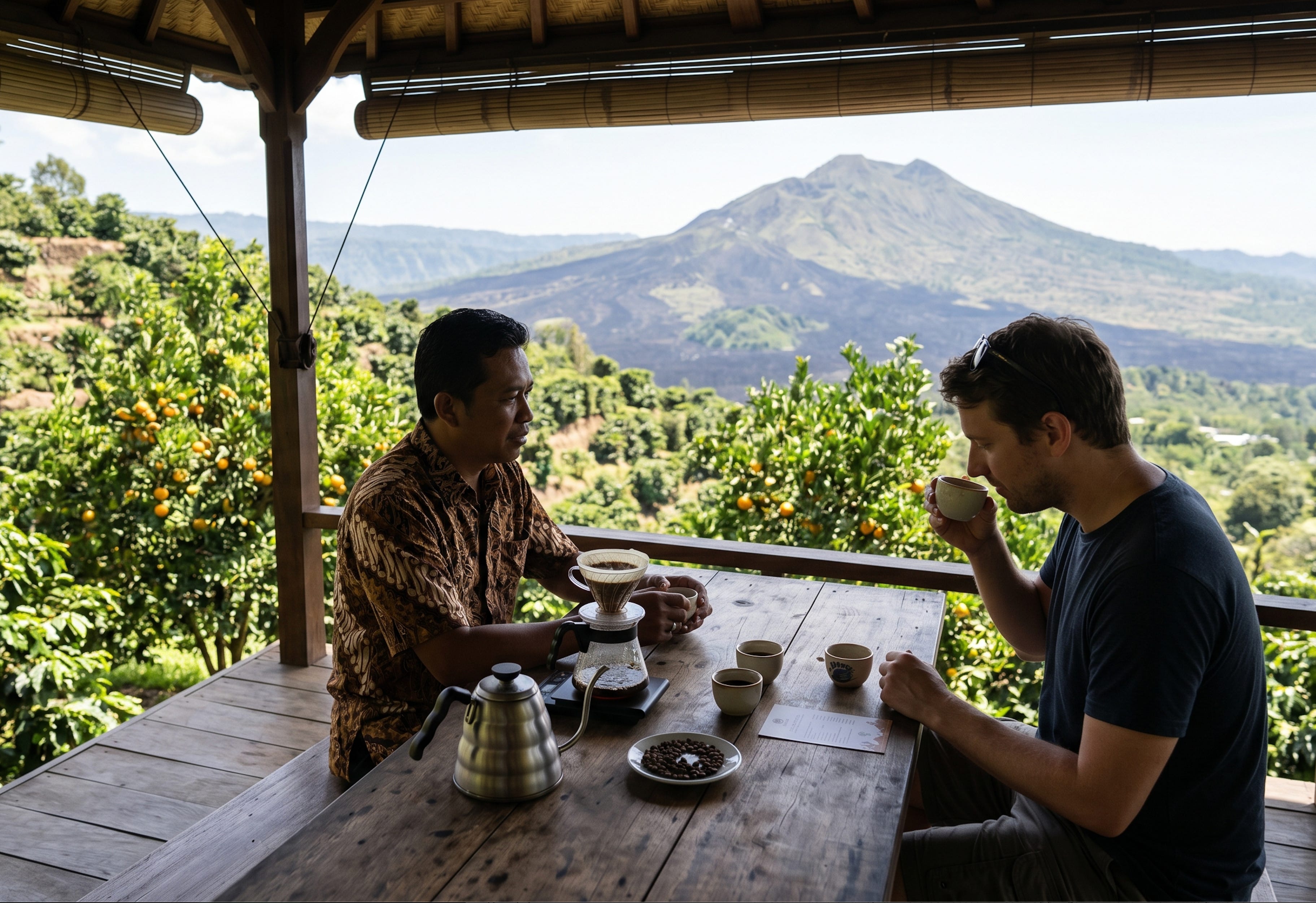
What makes Kintamani arabica truly distinctive is the traditional farming method. Coffee plants grow alongside citrus trees — mandarin and orange varieties, mainly. This is not decorative. The citrus provides natural shade. It protects the coffee from direct sun and wind. And it adds a subtle fruity character to the beans that tasters immediately recognise.
Most Kintamani farmers grow organically. Chemical fertilisers are rare. The approach is traditional, sustainable, and produces exceptional results. When you visit a Kintamani farm, you are seeing agriculture that has worked for generations.
The Best Plantation Tasting Tours to Visit
Segara Windhu Coffee Plantation
Segara Windhu sits along the road between Ubud and Kintamani. It is one of Bali’s most popular plantation stops — and for good reason. Visitors are guided to an open-air deck overlooking dense tropical jungle. A tasting tray arrives with up to 14 different coffees and teas. The tasting is free.
Guides walk you through each variety. They explain the growing process. They show you the roasting equipment. They answer questions patiently. The whole experience takes roughly an hour. It costs nothing beyond whatever you choose to buy in the shop. For budget-conscious travellers, this is outstanding value.
Bali Pulina
Bali Pulina sits just north of Ubud, near the Tegallalang rice terraces. It is smaller and slightly quieter than Segara Windhu. The tasting deck overlooks a steep river valley thick with palm trees.
A full tasting tray of eight to twelve local coffees and teas costs around IDR 65,000 (roughly £3). Bali Pulina opens daily from 9 a.m. to 5 p.m. Arrive before 10 a.m. for the calmest experience. The staff are welcoming and unhurried. You can take your time.
Kintamani highland farms
For something more authentic, head further into the Kintamani highlands. Smaller family-run farms offer tours where you can pick coffee cherries, watch the drying and roasting process, and taste freshly brewed cups with views of Mount Batur.
These farms are less polished than the tourist-facing plantations. That is the point. You are visiting working farms. The coffee is fresher. The experience is quieter. And your visit directly supports local farming families. Ask your driver or accommodation for recommendations — they almost always know someone.
From Farm to Cup: Bali’s Third Wave Coffee Scene
Speciality cafes worth visiting
Bali’s coffee scene has transformed since the early 2010s. A wave of speciality cafes now roast, brew, and serve single-origin Indonesian beans to international standards.
Seniman Coffee Studio in Ubud opened in 2010 and remains one of Bali’s most important coffee spaces. It has an on-site micro-roastery, a brew bar, and regular tasting workshops. You can learn to home-brew, roast, or perfect your espresso technique. Seniman treats coffee as craft. It is the opposite of a tourist plantation stop.
Revolver Espresso in Seminyak was one of the first cafes to champion speciality brews on the island. Tucked down a narrow alley, it feels like a Melbourne brew bar crossed with a New York speakeasy. Their house blend — sourced from Guatemala, Colombia, and Papua New Guinea — supplies cafes, restaurants, and hotels across Bali. Both are worth visiting. They show you what Bali’s coffee culture is becoming.
How local roasters are changing the game
A growing number of Balinese roasters now work directly with Kintamani farmers. They buy beans at fair prices. They roast in small batches. They sell directly to cafes and consumers. This cuts out middlemen and puts more money into farming communities. The result is better coffee for drinkers and better livelihoods for growers. It is a model that works. And it gives you a reason to buy beans locally before you fly home.
Making the Most of Your Coffee Tour
What to expect and what to bring
Most plantation tours are informal. You arrive. A guide greets you. You walk through the growing areas, see the processing steps, and sit down for a tasting. The whole visit takes between forty-five minutes and two hours.
Wear comfortable shoes. Some farms have uneven paths. Bring a light rain jacket — the highland weather can change quickly. Carry cash for purchases. Many smaller farms do not accept cards.
Tastings at the larger plantations are usually free or very low-cost. There is no obligation to buy. But if you enjoy what you taste, a bag of locally roasted beans makes an excellent souvenir. Expect to pay IDR 50,000 to IDR 150,000 for a quality bag.
Combining coffee tours with other stops
The best coffee farms sit along popular day-trip routes. Segara Windhu and Bali Pulina are both on the road from Ubud to Tegallalang and Kintamani. You can combine a plantation visit with the rice terraces, Mount Batur viewpoints, or Tirta Empul water temple.
Hire a private driver for the day. Costs run from IDR 500,000 to IDR 700,000 (roughly £25 to £35). Tell your driver you want to visit a working coffee farm — not a tourist trap. That one request changes everything.
Bali’s coffee story is far richer than kopi luwak. It is a story of volcanic highlands, traditional farming, and a speciality scene that rivals anything in Melbourne or London. The plantations worth visiting are the ones that show you the real process — no caged animals, no gimmicks, just honest coffee grown by people who care.
Skip the luwak stops. Head to Kintamani. Sit on a jungle deck at Segara Windhu with fourteen tastings in front of you. Visit Seniman in Ubud and learn how a single-origin is roasted. Buy beans directly from a highland farm.
Bali’s coffee culture deserves your time. And once you taste the real thing, you will never look at the tourist version the same way again.
FAQs
Q: Is kopi luwak worth trying in Bali?
Most ethical coffee experts advise against it. The majority of kopi luwak in Bali comes from caged civets kept in poor conditions. Producers often mislabel caged coffee as wild-sourced. The quality does not match the price. Your money is better spent on specialty Kintamani arabica, which is honestly produced and genuinely excellent.
Q: Are coffee plantation tours in Bali free?
Many are. Segara Windhu offers free tastings of up to 14 coffees and teas. Bali Pulina charges around IDR 65,000 for a full tasting tray. Smaller Kintamani farms may offer free or very low-cost tours. There is usually no obligation to buy, though purchasing a bag of beans supports the farmers directly.
Q: Where is the best coffee grown in Bali?
The Kintamani highlands produce Bali’s finest arabica. Grown at 1,000 to 1,200 metres alongside citrus trees, Kintamani coffee has bright acidity and citrus notes. It received Indonesia’s first Geographical Indication certification in 2008, recognising its unique quality.
Q: What is the difference between arabica and robusta in Bali?
A: Arabica grows in the cooler Kintamani highlands and has a smoother, more complex flavour. Robusta grows in warmer, lower-altitude areas and has a stronger, more bitter taste with higher caffeine. Both are widely used across Bali, but specialty coffee focuses almost exclusively on arabica.
Q: Can I visit a coffee plantation on a day trip from Ubud?
Yes. Segara Windhu and Bali Pulina are both within forty-five minutes of central Ubud. You can easily combine a plantation visit with the Tegallalang rice terraces or a trip to Kintamani. Hire a private driver for IDR 500,000 to IDR 700,000 for the day.
Q: What should I wear to a coffee plantation tour?
Comfortable closed-toe shoes are ideal. Paths can be uneven and muddy after rain. Bring a light rain jacket if you are heading to the highlands. Dress casually — there is no dress code. Sunscreen and a hat are helpful for open-air tasting decks.
Q: Are Bali’s coffee plantations suitable for children?
Most are family-friendly. The walking tours are gentle and short. Children enjoy seeing coffee cherries, watching the roasting process, and trying the tea samples. Larger plantations like Segara Windhu and Bali Pulina are well set up for families.
Q: What is third-wave coffee and where can I find it in Bali?
Third wave coffee treats coffee as an artisan product — focusing on origin, quality, and brewing technique. Seniman Coffee Studio in Ubud and Revolver Espresso in Seminyak are two of Bali’s best-known third-wave cafes. Both serve single-origin Indonesian beans and offer a world-class coffee experience.
Can I buy quality Bali coffee beans to take home?
Yes. Plantation shops, speciality cafes, and local roasters all sell beans. Expect to pay IDR 50,000 to IDR 150,000 for a quality bag. Kintamani arabica is the best souvenir for coffee lovers. Buy from roasters or farms directly for the freshest beans at the fairest prices.
When is the best time of year to visit Bali’s coffee plantations?
Coffee plantations are open year-round. The dry season — April to October — offers the most comfortable conditions for touring farms. Harvesting typically happens between May and September, so visiting during this period means you may see the full process from cherry to cup.
A note from Annie
Destined for Bali shares my personal experiences, opinions, and independent research. Everything I write reflects what I’ve found to be true at the time of publishing — but Bali changes constantly, and what works for me may not work for you. Always do your own research and seek qualified professional advice before making decisions about travel, visas, property, business, health, or anything else that matters. Some links in my posts are affiliate links, meaning I may earn a small commission at no extra cost to you. Sponsored content is always clearly labelled. Read the full Terms and Privacy Policy.