
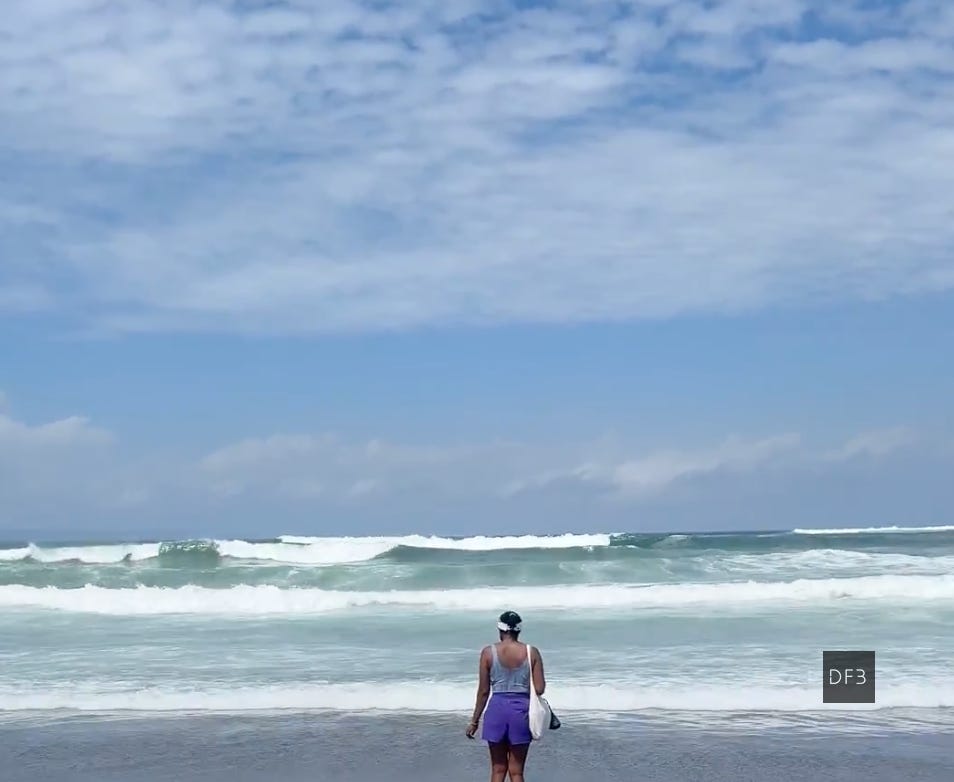
The question arrives with remarkable consistency, from remarkable variety of people. Family members ask it during video calls, tentative and careful. Old colleagues ask it when we catch up, curious and slightly wistful. Friends ask it over voice notes. Strangers on the internet ask it in comments. People I meet in Bali ask it, which has always struck me as a slightly funny phenomenon — asking a person who moved here whether they miss somewhere else whilst you are both standing in Bali.
The question is: But don’t you miss home?
Sometimes it comes in variations. Don’t you miss your family? (Yes.) Don’t you miss England? (Complicated.) Don’t you ever think about moving back? (Yes. Less so as time goes on.) Was it worth it? (Yes. Also complicated.)
I’ve been thinking about this question for long enough that I have a proper answer to it now. Not a clean one — the honest version of this answer resists cleanliness — but a real one. This is my attempt to give it.
The Honest Answer: Yes and No
The quick version is yes, sometimes, in specific ways. And no, not in the constant background way that people sometimes seem to expect.
I think people asking the question often imagine that missing home is a continuous state — that you carry it around with you, a steady low-grade ache, and that the absence of it would mean you’ve either found perfect peace or convinced yourself of something that isn’t quite true.
My actual experience is more discontinuous. I go long stretches — weeks, sometimes — without missing England in any active sense. I’m living, fully, in the life I have here. And then something happens — a Sunday morning that should have family in it, a friend’s message about something happening at home that I’m not part of, a specific smell or sound that triggers something unexpected — and the missing arrives sharply, clearly, without warning.
Both of these things are true. And the relationship between them has evolved significantly over the year and a half I’ve been here.
What I Miss (Specifically)
The things I miss are more specific than people expect.
I miss my family in a structural way — not desperately, most of the time, but in the way you miss something that should be closer. Sunday lunches. Being able to show up. The ease of proximity, which I took entirely for granted for decades and now think about quite a lot.
I miss British weather less than I thought I would and more than I expected to in specific moments. The smell of a cold autumn morning. The particular quality of afternoon light in November that has no equivalent here. The way the seasons announce themselves in England in a way that Bali, with its binary of wet and dry, doesn’t quite.
I miss certain foods in embarrassingly specific ways. A particular type of supermarket bread that I couldn’t justify missing but absolutely do. Proper Cheddar. The smell of a chippy on a cold evening. These are not significant losses. But they’re real ones, and I’ve stopped pretending they’re not.
I miss the ease of being somewhere I am culturally fluent. In England, I understand the codes. I can read a room, navigate an interaction, know what’s happening in a social situation without having to think about it. In Bali, I’m often a step behind, which is a good thing for my character and a mildly effortful thing for daily life.
What I Don’t Miss
I don’t miss the commute. I say this not as a cliché but as a genuine daily observation — the absence of the London commute from my life has made a measurable difference to my mental health that I underestimated before I left.
I don’t miss the weather in a general sense, only in the specific moments described above. The grey, relentless, apologetic weather of a British autumn and winter is not something that has left any gap in my life.
I don’t miss the cost of London. The way the city required a significant proportion of your income simply to exist within it, without much visible return in terms of joy. A cup of coffee here. A meal out here. The absence of the constant mental calculation of whether a thing is worth the cost.
And I don’t miss, if I’m honest, the particular rhythm of a life structured entirely by obligation and efficiency. The Bali pace was disorienting at first. Now it’s simply mine. The idea of returning to a life where my days were largely determined by external demands and very little space was left for anything else — that’s the thing I miss least about what I had before.
What “Home” Has Come to Mean
Here’s the thing nobody tells you about leaving: the concept of home becomes more complicated, not less.
For the first year, home was clearly England. Bali was where I lived — which is not, in the early months, the same as home. Home is the place you feel yourself most clearly, the place whose loss would feel like loss rather than change.
Somewhere in the second year, that shifted. Not all at once, but noticeably. I started referring to my villa as home without the mental asterisk. I started thinking about England as a place I’m from rather than a place I’m temporarily not in. I started having the thought — brief, unexpected, not yet fully formed — that if I moved back to England tomorrow, I would miss Bali.
I think home is less a place and more a set of conditions: people who know you, routines that anchor you, a sense of being legible to the place you’re in. England had those things because I’d spent a lifetime building them. Bali is building them now, more slowly, but they’re building.
I don’t have one home. I have two, to varying degrees. That’s an odd thing to have arrived at. It’s also, I think, an extraordinarily lucky one.
What I Tell People When I’m Being Honest
When someone asks me the question sincerely — not making conversation, but actually wanting to know — this is what I say.
Yes, I miss specific things. No, I don’t miss my life there. The distinction matters.
I think a lot of people who ask the question are really asking something else: Did you make the right choice? And if you did, what does that mean for the choice I’m not making? There’s a particular quality to the way people ask about expat life when they’re themselves considering it, or when they’d wanted to and didn’t, or when they’d never considered it and are wondering why someone would.
I try not to evangelise. Bali is the right decision for me, at this point in my life, and I think it would be the right decision for some of the people who ask. I also think it would be the wrong decision for others, and those others would know which they are if they were honest with themselves.
What I can say is this: I don’t regret it. Even the hard months — the sick month, the lonely January, the administrative chaos of the beginning — have contributed something. They’re part of the story of a life I chose rather than one that happened to me.
That’s not nothing. In fact, it might be everything.
Don’t you miss home? Yes. In specific ways, at specific moments, with specific intensity that fades and returns without warning.
But home, it turns out, is not a fixed point. It’s something you build, and something you carry, and something that can, if you’re willing to be patient and deliberate about it, exist in more than one place at once.
I miss England the way I imagine most people miss a version of their life that’s past — with fondness and some grief and the clear knowledge that you can’t have both things at the same time, so you choose the one that fits you better now. And then you make it home, gradually, for as long as it makes sense.
FAQs
Do expats in Bali miss home?
Most do, in varying degrees and specific ways. The experience tends to be discontinuous rather than constant — long periods of being fully present in Bali life, punctuated by sharp moments of missing what was left behind.
How do you deal with homesickness as an expat?
Regular video calls with family and friends, maintaining familiar rituals from home, building a strong local community, and travelling back occasionally all help. Most expats also find homesickness lessens significantly after the first year.
Is it normal to miss specific things about home rather than home in general?
Very. Most people find their homesickness is hyperspecific — a particular food, a particular smell, a particular Sunday routine — rather than a general feeling of missing everything.
Does moving to Bali change your sense of identity?
Yes, for most people who stay long-term. Living outside your home culture prompts significant reflection on what you actually value, who you are outside of context, and what home means.
Can you have more than one home?
Many long-term expats describe exactly this: a growing sense that they belong, to varying degrees, in more than one place simultaneously. It takes time and intention to build, but it’s possible.
Do British expats in Bali miss British culture specifically?
Often yes — particularly the ability to read social situations fluently, certain foods, and specific seasonal rituals. Christmas is frequently cited as the most challenging cultural absence.
How often do long-term Bali expats visit home?
It varies widely. Some go back annually; others less frequently. The cost of flights between Bali and the UK (£500–£900 depending on route and timing) is a practical factor.
Was moving to Bali worth it?
For most long-term residents who’ve stayed beyond the first year, yes. The common answer involves acknowledging that the hard parts were harder than expected, and the good parts were better.
What do you wish you’d known about homesickness before moving abroad?
That it’s specific rather than general. That it comes in waves rather than streams. And that it often coexists with being genuinely happy in your new life — the two are not mutually exclusive.
Does homesickness go away?
Largely. Most expats find that by the second year, the sharp edges of homesickness soften, and what remains is more like fondness for what was left behind than grief for the absence of it.
A note from Annie
Destined for Bali shares my personal experiences, opinions, and independent research. Everything I write reflects what I’ve found to be true at the time of publishing — but Bali changes constantly, and what works for me may not work for you. Always do your own research and seek qualified professional advice before making decisions about travel, visas, property, business, health, or anything else that matters. Some links in my posts are affiliate links, meaning I may earn a small commission at no extra cost to you. Sponsored content is always clearly labelled. Read the full Terms and Privacy Policy.