
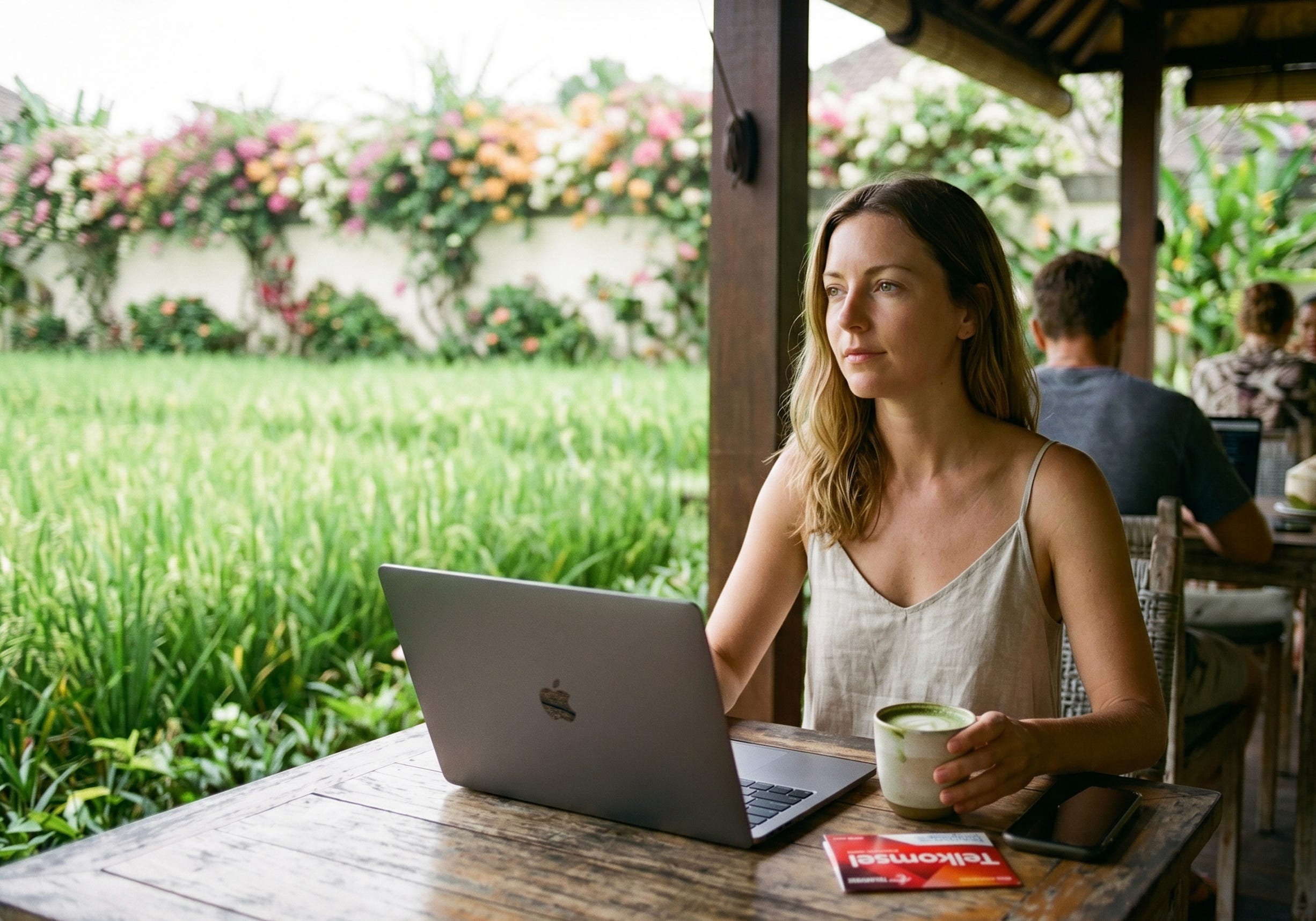
The photo is always the same. Open laptop. Tropical plants artfully blurred in the background. A matcha latte, sweating slightly in the humidity. Person looking thoughtfully into the middle distance, presumably composing something brilliant. Caption: “Office for the day ✨”
I know this photo well because I took it myself, in my first month in Bali, and it got fourteen times more engagement than anything I’ve posted since.
What the photo didn’t include: the three hours of connection problems before 10am. The power cut at noon that took the café’s wifi router with it. The fact that I got so little done that day that I worked until midnight to catch up. The creeping headache from the AC that alternated between “arctic” and “broken.”
I’ve been working from Bali cafés for nearly two years now. Here’s what a day actually looks like — the productive ones, the disasters, and the specific things I’ve figured out that make the difference between them.
The Morning Start: Why It Matters Which Café You Open With
In the Instagram version, you pick a beautiful café, open your laptop, and flow. In practice, your morning café sets the tone for the entire day, and making the wrong choice for the wrong kind of work costs you two to three hours minimum.
I learned this through painful experience. I was writing a pitch that needed sustained, uninterrupted focus. I chose a gorgeous rice-field café in Canggu because the view was spectacular and I’d had good coffee there before. What I hadn’t accounted for: it was a weekend, the place was at 90% capacity by 9 am, the wifi was shared across all those people, and someone near me was on a video call without headphones.
My rule now: for deep focus work — writing, code, analysis — I go to a coworking-style café that I know has strong, dedicated internet and doesn’t get too full before 11am. There are about four of these that I rotate through. For calls, I use my accommodation with my hotspot. The beautiful rice-field cafés are for afternoons when I’m doing lighter work: emails, admin, reading.
It sounds obvious in retrospect. It wasn’t obvious when I arrived.
The Connection Situation: Honest
Bali’s wifi has improved. This is true and worth saying. In 2026, the average connection in a well-run café in Canggu or Ubud is generally adequate for standard remote work — emails, document editing, lightweight video calls. The infrastructure is not London or Singapore, but it’s not the lottery it was five years ago.
But the key word is “average.” Café wifi in Bali is typically shared consumer broadband — the same connection that serves twenty tables of laptops, the café’s own admin system, and anyone in the building. At 9am on a Tuesday, it’s usually fine. At 11am on a Saturday when the café is full and three people are on Zoom calls? Not so fine.
My setup: I always carry a Telkomsel SIM card with a generous data allowance (IDR 150,000 per month for 100GB) as backup. When the café wifi struggles, I switch to hotspot without interrupting my work. This has saved my productivity more times than I can count. If you’re coming to Bali to work seriously, a reliable local SIM is not optional.
The Café Circuit: What’s Actually Good for Work
I’m not going to give you a list of photogenic cafés. There are hundreds of those guides. I’ll give you the specifics that matter for working rather than photographing.
For focused, quiet work: You want a café with AC or good air movement (heat kills focus), reserved quiet zones or at least low music, wifi that can be tested before you commit your morning, and enough seating that you’re not fighting for a power outlet. Several of the coworking-adjacent cafés in Berawa and Pererenan fit this description. In Ubud, the places slightly off the main drag on Jalan Bisma tend to be calmer than the central Monkey Forest road cafés.
For calls and meetings: Just use your accommodation. Café background noise — even in quiet places — is unpredictable enough that putting clients through it is a choice I avoid. I’ve taken exactly one client call from a café (when my accommodation wifi went down), and the background sound of a blender during the key part of the conversation was not an advertisement for the Bali office.
For lighter work and the aesthetic experience: The rice-field cafés and the beautiful open-sided spaces are genuinely wonderful for late morning emails, reading, or the work that doesn’t require total concentration. They’re what Bali offers that nowhere else does. Just don’t schedule your most demanding work there.
The Productivity Reality: What a Good Day and a Bad Day Look Like
A good working day from Bali cafés, when everything goes right, is genuinely as good as any day I’ve had in an office. The environment is beautiful. The coffee is excellent. The absence of a commute means you arrive at your first café already in a reasonable mental state. The light and the air, on a clear morning, do something to the quality of thinking that air-conditioned city offices don’t replicate.
A bad day — wifi problems, power cut, a café that’s become too full and too noisy, a wrong choice of location for the type of work I needed to do — leaves me more depleted than a bad day in a fixed office, because I’ve also spent cognitive energy managing logistics that should have been invisible.
The difference between the two is almost entirely preparation: knowing which cafés work for which types of work, having a backup connection, not booking calls from venues I can’t control, and accepting that Tuesday morning and Saturday morning are not the same experience even at the same café.
What I Wish I’d Known Before Year One
I wasted a lot of the first six months trying to work from the most beautiful spots in Bali rather than the most functional ones. I was performing remote work in paradise rather than actually doing it. The beautiful café, the rice field view, the matcha latte — all of that is real and genuinely lovely. But it belongs to the afternoons, not the deep work mornings.
The other thing I wish someone had told me: the humidity is a genuine productivity factor. High humidity without adequate cooling slows cognition in a way you notice after an hour and attribute to your project being harder than it is. The cafés with serious AC are not betraying Bali’s atmosphere — they’re the ones where you’ll get real work done.
And the social pull of the café circuit is its own thing. Bali’s coworking café culture has an energy that’s genuinely motivating — you’re surrounded by other people doing focused work, which creates a productive ambient effect. But the same culture means it’s very easy to spend forty minutes talking to an interesting stranger when you should be writing. The discipline required is the same discipline you’d need anywhere. Bali doesn’t give you a magic focus mode. It gives you an extraordinary setting in which to apply the focus you already have.
FAQs
Is the wifi in Bali cafés good enough for remote work?
Generally adequate for standard remote work in most established Canggu and Ubud cafés, but shared consumer connections can struggle during busy periods. Always have a local SIM card (Telkomsel recommended) as backup hotspot.
What is the best time of day to work from cafés in Bali?
Early morning (before 10am) typically offers the quietest conditions, best wifi performance, and coolest temperatures. Late afternoon can work for lighter tasks. Avoid Saturday and Sunday mornings at popular cafés if focused work is the priority.
Should I take client calls from a Bali café?
Generally not recommended. Background noise — even in quiet cafés — is unpredictable. Use your accommodation with a reliable connection for important calls and meetings.
What should I look for in a Bali café for remote work?
Good, dedicated wifi (ask or test before committing), power outlets near seating, reasonable noise levels, adequate air conditioning or airflow, and enough capacity that you’re not competing for table space during peak hours.
Is a local SIM card necessary for working in Bali?
Yes, if you’re doing serious remote work. A Telkomsel SIM with a generous data plan (IDR 100,000–200,000 per month for 50–100GB) provides reliable 4G backup when café wifi underperforms.
How does the humidity affect working outdoors in Bali cafés?
Significantly. High humidity without adequate air cooling impairs focus after an extended period. Open-sided cafés are better for short working sessions or light tasks. AC-equipped venues are better for sustained deep work.
What’s the difference between a coworking café and a regular café in Bali?
Coworking cafés (like those in the Dojo Bali orbit or BWork-adjacent venues) specifically cater to laptop workers: stronger, more reliable wifi, more power outlets, quieter zones, and typically slower table turnover. Regular cafés are more variable in their work-friendliness.
— A note from Anne. Destined for Bali shares personal experiences and opinions. Everything reflects what I’ve found to be true at the time of writing. Your café experience may vary — Bali has thousands of them, and new good ones open regularly.