
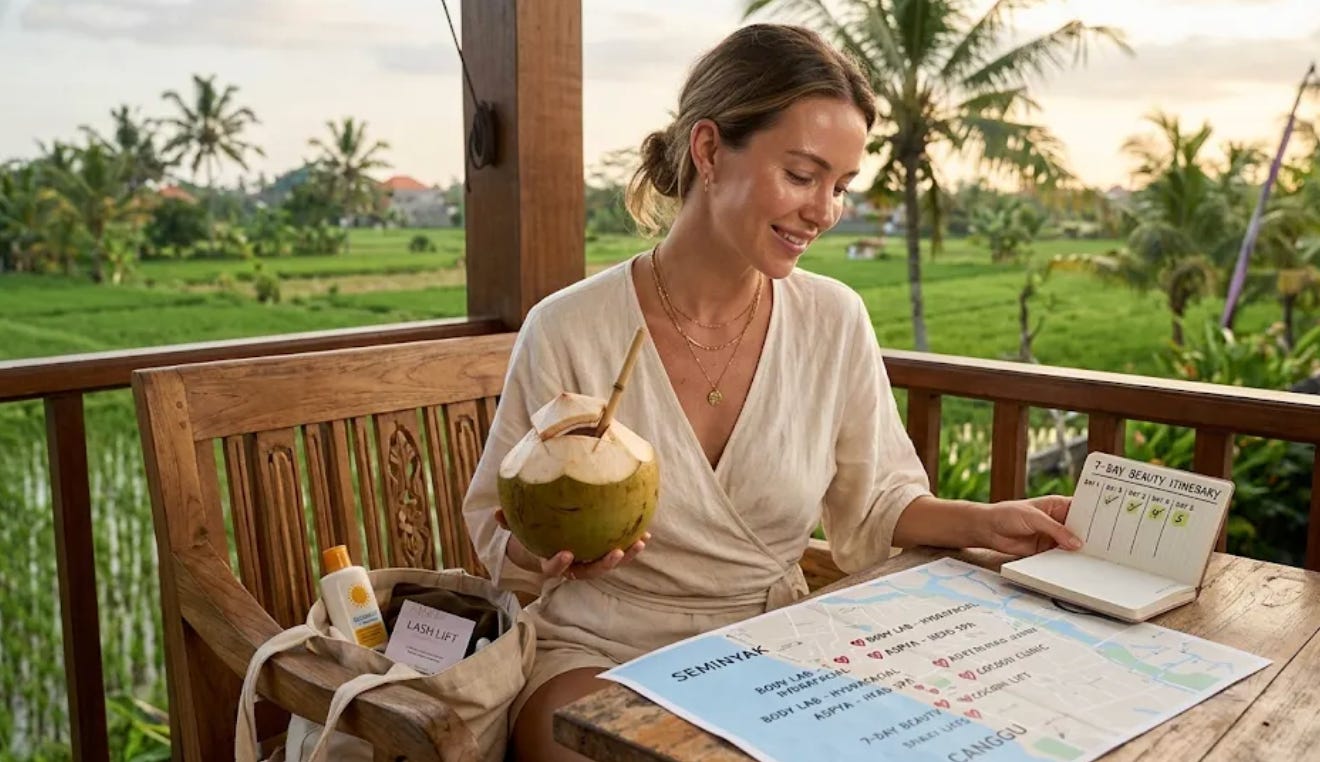
I know someone who chose her Bali accommodation entirely based on which neighbourhood would give her the shortest route to three specific clinics. She had her HydraFacial booked before she had her flights confirmed. She spent ten days in Bali, came home looking extraordinary, and has not stopped recommending the trip to everyone she knows.
Two years ago, this would have seemed like an unusual approach to a holiday. Now it is a recognisable pattern. People are not just fitting a massage or a facial into their Bali itinerary — they are building their Bali beauty itinerary first, and arranging everything else around it. Which area to stay in, which days to keep free, how long to spend somewhere before flying home. The treatments are the anchor, and the rest of the trip is designed to complement them.
This guide is for anyone planning a Bali trip who wants to do it properly — with the beauty schedule as thoughtful and intentional as the restaurant list. Because done well, it produces results that genuinely transform how you look and feel for weeks after you land back home. And done badly, you end up with a HydraFacial on your last afternoon and a twelve-hour flight two hours later.
Why Bali Has Become a Beauty Destination in Its Own Right
The Shift From “Spa Day” to “The Whole Point of the Trip”
Something shifted in the last two or three years. Bali’s spas and wellness culture have always been part of the island’s appeal — anybody who has been knows the feeling of a Balinese massage that seems to unkink things that have been knotted for months. But the conversation has changed. What used to be a nice add-on (”maybe we’ll do a spa day”) has become, for a growing number of travellers, the primary reason for the trip.
The reasons are not complicated. Bali now offers clinical-grade aesthetic treatments — HydraFacials, PDRN boosters, PRP, HIFU, IV beauty drips, Sylfirm X, Botox — at prices that are 62–88% lower than equivalent London or Sydney clinics. A full week of comprehensive treatments in Bali costs less than a single procedure at home. Once people realise this, the maths rather speaks for itself.
Then there is the environment. Bali’s combination of humidity, excellent food, restorative sleep, and the absence of a commute creates a physiological baseline for skin that most people in Northern Europe simply do not have in daily life. Treatments work better when the skin is rested, hydrated, and not inflamed by stress and cold. Bali provides all of that without you having to think about it.
The New Bali Beauty Traveller: Who Is Actually Doing This?
Short-Stay Tourists, Digital Nomads, and the “Glowmad”
Beauty tourism in Bali attracts three distinct types of visitor, and understanding which one you are shapes how you should plan.
Short-stay tourists (one to two weeks) are often looking for a curated selection: two or three key treatments that they could not otherwise afford at home, plus the traditional spa experiences that make Bali special. For this group, prioritisation matters — you cannot do everything, so knowing what will produce the most noticeable results in a short window is important.
Digital nomads and longer-stay visitors (one month or more) approach it differently. They have time for treatments that require multiple sessions — a series of LED therapy, a course of HIFU, a PRP treatment followed by a follow-up session. For this group, Bali’s beauty calendar can genuinely run in parallel with their work schedule. Tuesday and Thursday mornings at the clinic, the rest of the week at the coworking space.
Glowmads are the travel industry’s emerging category for visitors who plan their trip around beauty appointments above all else. These are people who might have two weeks off and consciously choose Bali — over a beach holiday in Europe, over a city break — specifically because of what they can achieve in that window for their skin, hair, and overall appearance. They tend to research intensively before they fly, arrive with appointments pre-booked, and leave with results that take months to replicate (or match in cost) at home.
How to Structure Your Bali Beauty Itinerary
The Golden Rule: Sequence Matters
The most common mistake in Bali beauty planning is booking treatments in the wrong order. Not because the treatments conflict, but because the results of some treatments are best enjoyed with maximum time to develop, and the downtime of others (however minimal) needs to be factored in.
Here is the framework I work to:
Days 1–2: Recover and hydrate. Do not book anything clinical on your arrival day or the day after. Your skin is dehydrated from travel, your sleep is disrupted, and you will not get the best results from any treatment. Drink coconut water. Sleep. Let the humidity start working.
Day 3–4: Restorative treatments. A traditional lulur body scrub, a herbal compress massage, or a nourishing facial. These prepare the skin and are genuinely restorative for travel-tired bodies. No downtime, immediate benefit.
Day 5–6: Clinical treatments. HydraFacial, oxygen facial, LED therapy, or a PDRN / skin booster session. Your skin is now rested and in its best condition to respond. Schedule these with at least 4–5 days remaining in your trip so you can see the full results before you leave.
Day 7–8: Injectables, if applicable. Botox and filler results develop over 7–14 days; booking these early-mid trip means you will see meaningful results before you fly. Allow 2 weeks before any major event for potential minor bruising to fully clear.
Days 8–10: Hair, nails, lashes, brows. These are the “finishing touches” — best done later in the trip so the results are fresh when you get home.
Final day: Japanese head spa or a Balinese massage. Go home feeling completely reset.
A Sample Week-Long Schedule
For a seven-day trip, a practical Bali beauty itinerary might look like this:
Day 1: Arrive. Coconut water, pool, sleep.
Day 2: Morning massage at villa or local spa. Gentle start.
Day 3: Lulur scrub and traditional Balinese facial.
Day 4: HydraFacial MD + LED light therapy add-on.
Day 5: Lash lift and tint, brow lamination, keratin blowout.
Day 6: Beauty IV drip (morning), gel manicure and pedicure (afternoon).
Day 7: Japanese head spa. Done.
Total treatment spend in Bali: approximately £130–£200 depending on clinics chosen. Equivalent UK spend: well over £1,000.
The Logistics Nobody Talks About: Bali Traffic and Appointment Planning
How to Cluster Your Appointments to Save Your Sanity
Bali traffic is one of the things that catches first-time visitors entirely off guard. A ten-kilometre journey in Seminyak during the middle of the day can take forty-five minutes to an hour. On a bad day, longer. This becomes relevant the moment you have a facial booked at 11am in Legian and a nail appointment at 1pm in Canggu and you are staying in Ubud.
The practical solution is clustering: book all your Seminyak and Legian appointments on the same day; all your Canggu appointments on another. This is not just about efficiency — it also means you are not arriving at a treatment stressed and sweating from a traffic delay, which rather defeats the point.
If your accommodation is in Ubud, factor in a 45-minute to 90-minute transfer to reach Seminyak or Canggu clinics depending on time of day. The best strategy for Ubud-based visitors is to batch two or three treatments in a single south Bali day trip, or to choose clinics in Ubud itself (Healthy Look Aesthetic, Bali’s traditional spa scene). Ubud is genuinely excellent for traditional and wellness treatments; it is less convenient for the full clinical menu.
Uluwatu visitors are best served by THE X Beauty Lounge for clinical needs, supplemented by mobile beauty providers for treatments that travel to you.
How to Build Your Treatment Budget
What a Realistic Week Costs vs What the Same Week Costs at Home
Being honest about budget before you go saves a lot of mid-trip decision fatigue. Here is a realistic breakdown for a well-curated week of Bali beauty treatments, using typical 2026 prices at mid-range to premium providers:
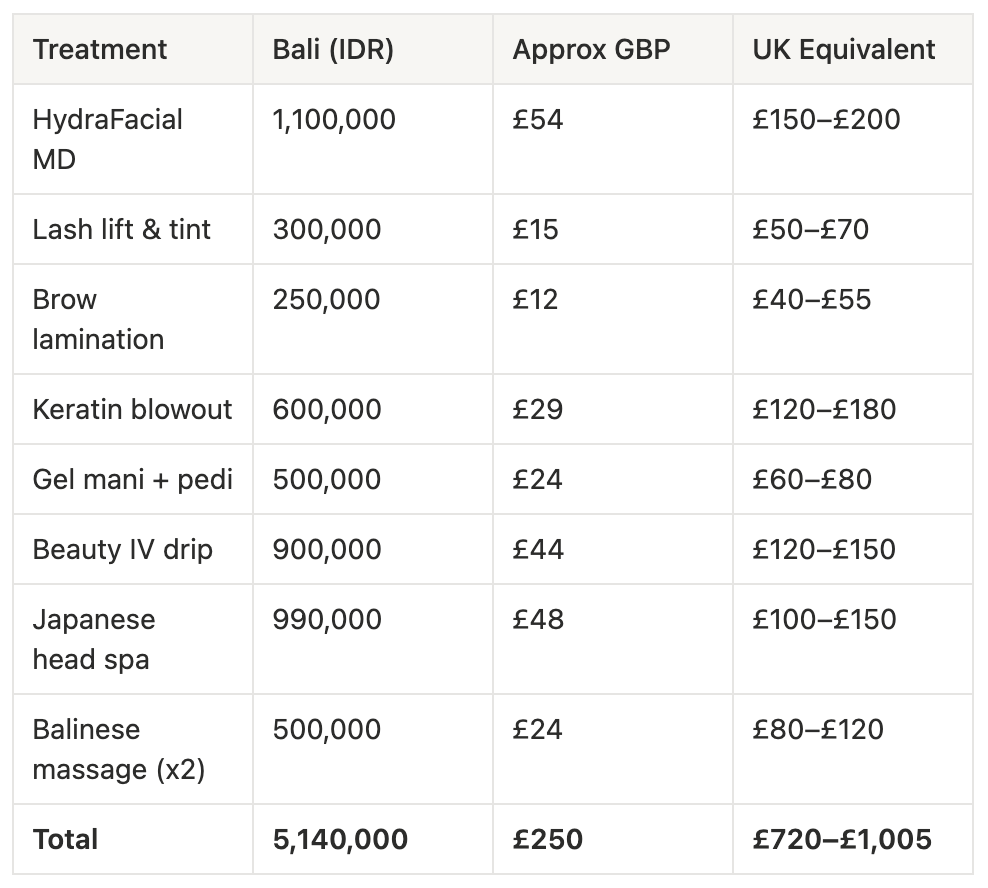
And that is a comprehensive week with eight separate treatments. You would be paying three to four times as much for the same menu in London.
Booking Strategy: When and How to Lock Everything In
What to Book Before You Fly and What to Leave Flexible
Some things are worth booking before you fly: clinical treatments that are in demand (HydraFacial at Body Lab, Japanese head spa at ASPYA, the more advanced medi-spa procedures at Cocoon or Healthy Look Aesthetic), especially if you are travelling during July, August, or December. These fill up weeks in advance with peak-season visitors who arrive with the same idea you have.
Everything else — nail appointments, basic massage bookings, standard facials — can generally be arranged within 24–48 hours of wanting them, even in peak season. Flexibility in the secondary treatments gives you room to adjust your schedule based on how your skin is actually responding.
For Botox or fillers at any of the recommended clinics, book your consultation as soon as your dates are confirmed. The consultation can usually be done remotely (via WhatsApp or email) for returning clients, or in person on your first or second day. The treatment itself needs the consultation to precede it, so do not leave this too late.
One last thing: leave your last full day in Bali open for something gentle and unbooked. A walk, a final pool afternoon, one more amazing meal. The beauty schedule serves the holiday, not the other way round.
Conclusion
The tourists building their whole trip around Bali beauty appointments are not doing something unusual. They are doing something rational. They have realised that Bali offers a rare combination: world-class treatments, extraordinary pricing, an environment that makes everything work better, and enough variety that a week of focused beauty travel produces results that would take a year and a very different budget to replicate at home.
Plan the sequence thoughtfully. Cluster by geography. Book the high-demand treatments before you fly. Leave the last day open. And then, when you land back home and people ask what you did in Bali — let them look at your skin.
Have questions about building your own Bali beauty schedule? Drop them in the comments — I read every single one.
FAQs
Q: Is it worth planning a holiday specifically around beauty treatments in Bali?
A: Absolutely. Bali offers 62–88% savings on clinical aesthetic treatments compared to London or Sydney equivalents, combined with world-class spas, mobile treatment services, and an environment (humidity, restorative sleep, clean food) that genuinely improves treatment results. A week of comprehensive beauty treatments in Bali costs less than a single procedure at most Western clinics.
Q: What treatments should I prioritise for a one-week Bali beauty trip?
A: For maximum impact in seven days: a HydraFacial or clinical facial mid-trip (days 4–5, after skin has settled from travel), a lash lift, brow lamination, and keratin blowout towards the end (days 5–6 for fresh results at home), a beauty IV drip for systemic skin support, and a traditional lulur or Balinese massage in the first few days. A head spa on your final day is an excellent way to close the week.
Q: How far in advance should I book Bali beauty treatments?
A: Clinical treatments at popular clinics (HydraFacial at Body Lab, Japanese head spa at ASPYA, medi-spa procedures at Cocoon or Healthy Look Aesthetic) should be booked 1–3 weeks before travel during peak season (July, August, December). Standard beauty services (nails, basic massage, facials at less specialist spas) can usually be booked 24–48 hours in advance.
Q: What is a “Glowmad” and am I one?
A: A Glowmad is a traveller who plans their trip primarily around beauty and aesthetic treatments rather than sightseeing or nightlife. Travel industry analysts coined the term to describe Bali’s growing segment of visitors — predominantly women in their late twenties to mid-forties — who choose Bali specifically for its combination of exceptional treatments and dramatically lower prices compared to Western countries.
Q: How do I deal with Bali’s traffic when planning beauty appointments?
A: Cluster appointments geographically rather than chronologically. Book all your Seminyak/Legian treatments on one day and all your Canggu appointments on another. Build in at least 30–60 minutes travel buffer for any appointment in a different area. Use Google Maps to check real-time traffic before you leave. Mobile services (treatments that come to your villa) eliminate the traffic problem entirely for anything that travels well.
Q: How much should I budget for a week of beauty treatments in Bali?
A: A well-curated week covering eight comprehensive treatments (HydraFacial, lash lift, brow lamination, keratin blowout, gel mani/pedi, IV drip, head spa, and two massages) costs approximately £200–£260 GBP at mid-range to premium providers. The equivalent treatment menu in London would cost £720–£1,000 or more.
Q: Which area of Bali is best to stay in for a beauty-focused trip?
A: Seminyak or Legian gives you the best access to the highest concentration of quality clinics and salons — Cocoon, Body Lab, Mello Spa, and ASPYA are all here. Canggu is excellent if you prefer a more relaxed atmosphere and want good Firefly Laser access. Ubud is beautiful for traditional wellness and some clinical treatments (Healthy Look Aesthetic). Uluwatu works well if you are combining beauty with surfing and THE X Beauty Lounge meets your clinical needs.
Q: Can I combine a beach holiday with a Bali beauty itinerary?
A: Yes, and most people do. The key is timing: avoid the beach on days when you have had acid peels or laser treatments (2–3 days minimum). Non-invasive treatments — massage, lulur, HydraFacial, LED, nails, lashes — have zero downtime and can be followed immediately by pool or beach time with SPF applied. Schedule your more intense clinical treatments earlier in the trip and your finishing touch treatments towards the end.
Q: Do I need to speak Indonesian to book beauty treatments in Bali?
A: No. English is widely spoken across Bali’s beauty and clinic sector, particularly in Seminyak, Canggu, and Ubud. WhatsApp booking (which is how most providers communicate) allows you to be as precise as you need to be in writing. All the clinics mentioned in this guide communicate comfortably in English.
Q: What should I bring to get the most from Bali’s beauty treatments?
A: A high-SPF sunscreen (essential — you will be in more intense sun than at home and some treatments increase photosensitivity). A list of any allergies or skin sensitivities to share with therapists. Your regular skincare routine for the evenings (do not experiment with new products mid-trip while your skin is also processing treatments). And realistic expectations: even in Bali, one facial does not undo years. A thoughtfully sequenced week, though? That really does show.
A note from Annie
Destined for Bali shares my personal experiences, opinions, and independent research. Everything I write reflects what I’ve found to be true at the time of publishing — but Bali changes constantly, and what works for me may not work for you. Always do your own research and seek qualified professional advice before making decisions about travel, visas, property, business, health, or anything else that matters. Some links in my posts are affiliate links, meaning I may earn a small commission at no extra cost to you. Sponsored content is always clearly labelled. Read the full Terms and Privacy Policy.