
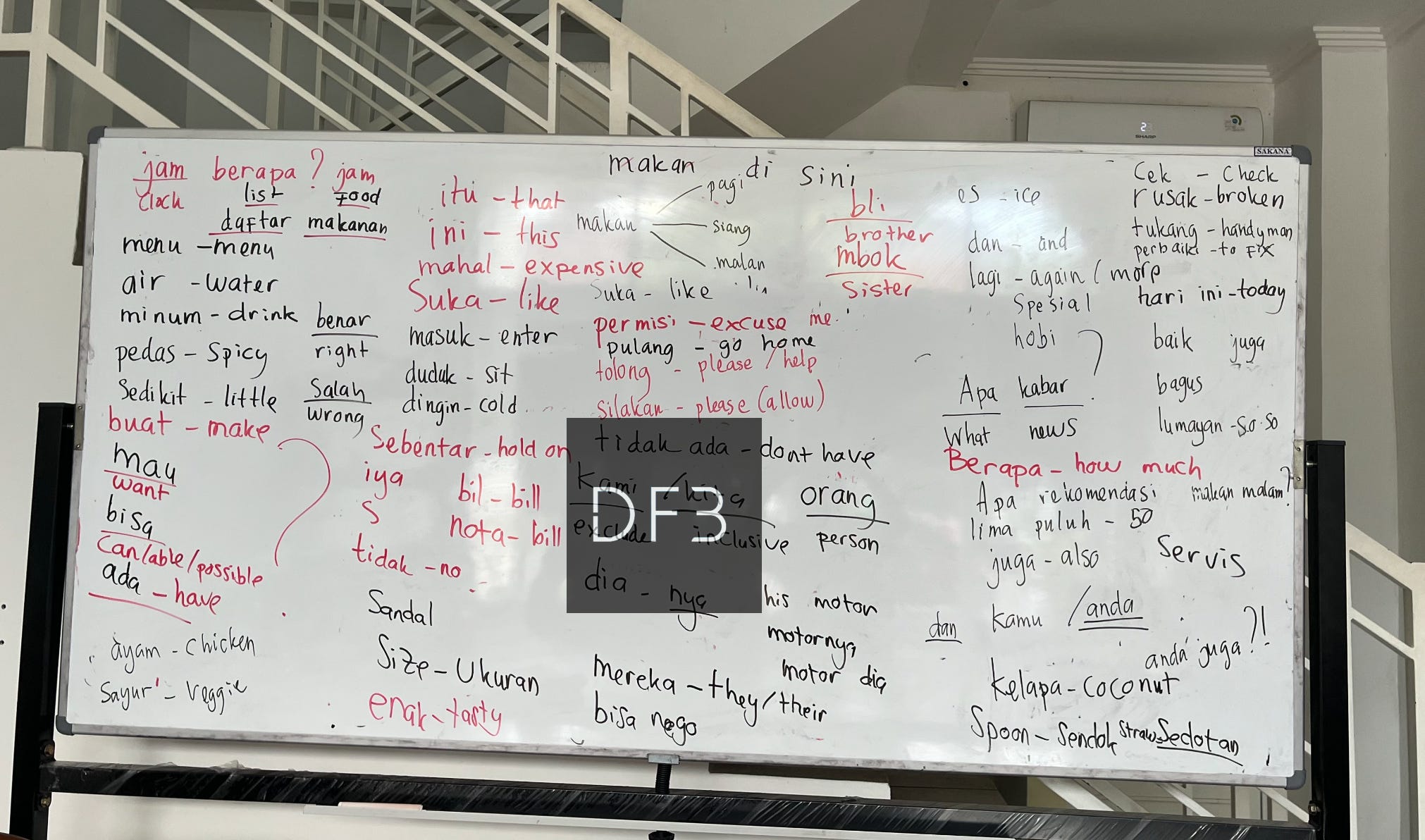
I’d been visiting Bali for a few years before I learned anything beyond “terima kasih”. I was managing fine — most people in tourist areas speak some English, and polite gestures get you further than you expect. Then a friend who’d been living in Ubud for eighteen months started speaking to the warung owner in Bahasa, and I watched the entire tone of the conversation change. Not dramatically, but noticeably. The warmth was different. The price was different. The relationship was different.
I started learning the following week.
This article is about why learning Indonesian in Bali is worth the effort, why it’s considerably less daunting than most Asian languages, and the most practical way to get started from wherever you currently are.
Why Bahasa Indonesia Is Worth Learning (and Easier Than You Think)
For English speakers, Indonesian is one of the more accessible Asian languages. It uses the Roman alphabet — no new script to learn. It has no tones, which removes one of the most intimidating features of languages like Mandarin or Thai. Pronunciation is consistent and phonetic — words are pronounced roughly as they’re spelt. And the grammar, while it has its own logic, doesn’t require the complex conjugation systems of European languages. Verbs don’t change form based on who’s acting. Tense is indicated by time words (“yesterday”, “tomorrow”, “already”) rather than verb endings. This is genuinely simpler than it sounds.
For context: the US Foreign Service Institute rates Indonesian as a Category II language (moderate difficulty for English speakers), estimating around 900 classroom hours to reach professional working proficiency. That’s significantly easier than Japanese, Arabic, or Chinese (Category IV, 2,200+ hours). Conversational competency for everyday Bali life is achievable in weeks to months, not years.
And the reason to learn isn’t proficiency for its own sake. It’s the shift in what becomes available to you. The warung owner doesn’t speak English. The healer who can’t be translated. The market stallholder who respects you differently when you ask the price in Indonesian. The deeper conversations with neighbours, landlords, and local friends that English simply doesn’t reach.
Indonesian vs Balinese — Understanding the Difference
Bahasa Indonesia is the national language of Indonesia — a standardised language used as a lingua franca across the archipelago and taught in all schools. Everyone in Bali speaks it and, in most working and social contexts, uses it.
Balinese is a distinct local language spoken within Bali, with its own vocabulary, grammar, and a complex formal register system that reflects traditional social hierarchy. It’s the language of the home, of ceremony, and of close community. Most younger Balinese Indonesians are more comfortable in Indonesian than in Balinese, particularly in tourist areas.
For a visitor or new expat, learning Indonesian is the useful choice: it unlocks communication across all of Bali (and all of Indonesia). Learning Balinese is a longer and more niche project, though even a handful of Balinese words — “suksma” (thank you), “campura” (mixed, as in nasi campura), “rah” (blood, which comes up in ceremonial contexts) — signals a level of interest in local culture that Balinese people consistently appreciate.
The Phrases That Actually Change Things
Greetings and politeness
The basics that pay dividends immediately:
Selamat pagi — Good morning (used until about 11 am)
Selamat siang — Good afternoon (11 am to around 3 pm)
Selamat sore — Good late afternoon/early evening
Selamat malam — Good evening/night
Apa kabar? — How are you? (literally “what’s the news?”)
Kabar baik — I’m well (the standard response)
Terima kasih — Thank you
Sama-sama — You’re welcome (literally “same-same”)
Permisi — Excuse me
Maaf — Sorry
Use the appropriate time-of-day greeting instead of a generic “hello” and you’ll see a visible difference in how interactions begin. It signals that you know where you are and are paying attention.
Practical phrases for daily life
Berapa harganya? — How much does it cost?
Terlalu mahal — Too expensive (essential for markets)
Di mana...? — Where is...?
Saya mau... — I would like...
Tidak mau — I don’t want (useful, politely)
Tolong — Please / Help
Bisa? — Is it possible?
Sudah — Already / Finished (you’ll hear this constantly and use it often)
Belum — Not yet (the specific opposite of sudah — Indonesian distinguishes between “not yet” and “never”)
Enak — Delicious / Nice (extremely useful at warungs)
Market and bargaining phrases
Bisa kurang? — Can you go lower? (gentle opening for bargaining)
Harga terakhir? — What’s your final price?
Mahal sekali — Very expensive (said with a friendly smile)
Nggak — Informal “no” (softer and more colloquial than “tidak”)
Oke — OK (borrowed directly from English, universally understood)
How to Learn — Classes, Apps, and the Immersion Approach
Language schools in Bali
Cinta Bahasa is one of the most established Indonesian language schools in Bali, with locations in Ubud and Sanur. They offer month-long beginner group courses as well as private lessons and online options. The group course format is particularly useful if you’ve just arrived — it provides structure, community with other new arrivals facing the same settling-in process, and a regular reason to leave the villa and engage with something.
IndoLingo in Canggu operates primarily one-on-one, which suits people working on specific goals (business conversations, understanding legal documents, building conversational confidence). The smaller-scale, personalised approach is better if you already have some foundation.
Bali Language Services in Ubud offers a range of classes across levels and also provides cultural context alongside language, which for anyone planning to engage seriously with Balinese life is valuable.
Apps and self-study
Duolingo has an Indonesian course and is good for building vocabulary and basic sentence structure, though it doesn’t capture spoken Indonesian well. Pimsleur’s Indonesian audio course is better for pronunciation and conversational rhythm — particularly useful for the first few weeks when hearing the language correctly matters. Memrise and Anki are useful for vocabulary retention through spaced repetition.
Google Translate’s offline Indonesian mode is worth downloading before you arrive and is a practical crutch during the early weeks while you’re building vocabulary. Use it as a starting point, not a substitute for learning.
The immersion method
The fastest route, if you have the nerve for it, is simply to start using the language. Order food in Indonesian. Thank people in Indonesian. Ask prices in Indonesian. Make the mistakes, accept the corrections graciously, and build from what happens.
Balinese people are consistently patient and encouraging with foreigners making genuine efforts with the language. Nobody will laugh at you for getting a phrase wrong. Most people will gently correct you and be visibly pleased that you’re trying. The embarrassment barrier is lower here than it is almost anywhere.
If you’re doing a cooking class that includes a market visit (as covered in another article here), this is a particularly good place to practise basic vocabulary in a low-stakes, guided context.
What Happens When You Start Using It
This is the part that’s hard to explain and easy to experience. When you start speaking Indonesian in Bali, even badly and haltingly, something changes. You’re no longer operating entirely through a glass screen of tourism. You’re engaging with the actual place rather than the version of it designed to be accessible to people who don’t know the language.
The warung owner who served you three times with polite efficiency will have a completely different conversation with you when you stumble through “selamat pagi, saya mau nasi campur, enak sekali kemarin” (good morning, I’d like nasi campur, it was very delicious yesterday). She will laugh, probably. She might correct you. She will remember you. And the next time you come in, something will have shifted.
This is the actual value of learning the language, and it’s not about fluency. It’s about the signal your effort sends: I am here, I see this as a real place with real people, and I am making an effort to meet you rather than waiting for you to meet me. That signal is understood and returned every time.
Learning Indonesian in Bali is one of the few things I’d recommend to almost anyone, regardless of how long they’re staying. A week of basic phrases changes daily interactions. A month of deliberate learning opens a different layer of the island. A year of consistent practice gives you access to a version of Bali that most visitors never reach.
Start with the greetings. Try them tomorrow morning at wherever you get breakfast. Notice the difference. Then keep going from there.
If you’ve been learning Indonesian in Bali, I’d love to hear how it’s going and what’s worked best for you. Leave a note in the comments.
FAQs
1. Is it worth learning Bahasa Indonesia if you’re only in Bali for a week?
Even a handful of phrases — greetings, thank you, how much does it cost — meaningfully changes daily interactions with Balinese people. A week is enough to learn and practise the basics. It’s one of the best returns on investment of any preparation you can do before arriving.
2. How hard is Bahasa Indonesia for English speakers?
Considerably easier than most Asian languages. Indonesian uses Roman script, has no tones, and features consistent phonetic pronunciation. Grammar is relatively simple: no gendered nouns, no complex verb conjugation, and tense is indicated by time words rather than verb endings. Basic conversational competency is achievable in weeks to months.
3. What is the difference between Bahasa Indonesia and Balinese?
Bahasa Indonesia is the national language, used across Indonesia and taught in all schools. Balinese is a separate local language spoken within Bali, with its own vocabulary and formal register system based on social hierarchy. For visitors and expats, learning Indonesian is the practical choice. A few Balinese words (like “suksma” for thank you) are a bonus.
4. What are the most useful Indonesian phrases for Bali?
The most immediately useful phrases are: selamat pagi/siang/sore/malam (time-appropriate greetings), terima kasih (thank you), berapa harganya? (how much?), enak (delicious), bisa kurang? (can you go lower?), di mana...? (where is...?), and saya mau... (I would like...). These cover most daily situations.
5. Where can I take Indonesian language classes in Bali?
Cinta Bahasa (Ubud and Sanur) offers month-long beginner group courses and private lessons. IndoLingo (Canggu) specialises in one-on-one lessons. Bali Language Services (Ubud) offers courses with cultural context. Online options from these schools are also available for those who want to start before arriving.
6. What apps are best for learning Indonesian?
Duolingo (Indonesian course), Pimsleur (audio-focused, good for pronunciation), Memrise (vocabulary), and Anki (spaced repetition for vocabulary retention) are all useful. Google Translate with offline Indonesian downloaded is a practical daily tool during the early learning phase.
7. Will Balinese people understand me if I speak Indonesian?
Yes. Bahasa Indonesia is spoken and understood by everyone in Bali. It’s the language of education, commerce, and public life. Balinese is spoken within families and communities but Indonesian is the shared language across all groups.
8. Is Bahasa Indonesia useful beyond Bali?
Yes — Bahasa Indonesia is mutually intelligible with Bahasa Malay, meaning it also works in Malaysia, Brunei, and parts of Singapore. As the language of the world’s fourth most populous country, it has real utility across Southeast Asia.
9. How do Balinese people react when foreigners speak Indonesian?
Consistently positively. Most Balinese people are patient and encouraging with foreigners making genuine language efforts, will gently correct mistakes, and are visibly appreciative that someone has taken the time to learn. It changes the dynamic of almost every interaction.
10. What’s the difference between “tidak” and “belum” in Indonesian?
“Tidak” means “no” or “not” as an outright negation. “Belum” means “not yet” — a crucial distinction in Indonesian that English doesn’t capture in a single word. “Saya tidak makan” means “I don’t eat”; “saya belum makan” means “I haven’t eaten yet.” Understanding this distinction early on removes a lot of ambiguity in conversation.
A note from Annie
Destined for Bali shares my personal experiences, opinions, and independent research. Everything I write reflects what I’ve found to be true at the time of publishing — but Bali changes constantly, and what works for me may not work for you. Always do your own research and seek qualified professional advice before making decisions about travel, visas, property, business, health, or anything else that matters. Some links in my posts are affiliate links, meaning I may earn a small commission at no extra cost to you. Sponsored content is always clearly labelled. Read the full Terms and Privacy Policy.