
There is a particular form of love that involves watching something change and not being able to stop it. Parents feel it. People who grew up in neighbourhoods that have gentrified feel it. And people who move to a place they adore and then watch it shift, year by year, under the weight of its own popularity — they feel it too.
I love Bali. I want to be clear about that from the start, because what I’m about to say could be read as complaint, and it isn’t exactly. It’s more like the particular clarity that comes from caring about something enough to look at it honestly.
Bali is changing. It has always been changing — every place does — but the pace of change in 2026 is different from what it was even five years ago. The tourist numbers are up. The development is relentless. Parts of the island that were quiet when I arrived are no longer quiet. And I sit with this as someone who is, undeniably, part of the phenomenon I’m uncomfortable about.
This is an attempt to think through that honestly.
What Has Changed (Even in the Time I’ve Been Here)
In the eighteen months I’ve been in Bali, I’ve watched a handful of rice fields near Canggu become building sites. I’ve watched a road I used to take to avoid traffic become a road that now generates traffic. I’ve watched prices for accommodation, food, and services rise in a way that’s good for the Balinese people earning that money and complicated for the character of the place.
The digital nomad and remote work boom, accelerated by the pandemic and sustained by the normalisation of remote working, brought a significant wave of longer-term foreign residents — people like me — to Bali from around 2021 onwards. The infrastructure hasn’t entirely kept pace. The roads weren’t designed for these volumes. The water supply in some areas is under pressure. The waste management system, always strained, is more strained.
Bali’s government has been grappling with this visibly. There have been regulations on tourist behaviour at sacred sites, crackdowns on foreigners working illegally, debates about visitor fees and caps. Some of these measures are genuinely positive. Some are reactive rather than structural. None of them have yet fundamentally changed the trajectory.
This is not Bali’s fault. It is, partly, the fault of everyone who came.
The Uncomfortable Position of the Expat
Here is the thing I have had to sit with, and haven’t fully resolved: I am part of the problem I’m describing.
I came to Bali because I loved it. Because it offered something I couldn’t find in the UK: a different pace, a different quality of daily life, a lower cost of living that gave me freedom I didn’t have before. These are not bad reasons. They are, in fact, the reasons most people come.
But the aggregate effect of many people coming for exactly these reasons — and staying longer than tourists, and driving up rental prices, and bringing the commercial ecosystem that caters to them — is part of what’s changing Bali in ways that make it less like the place everyone came for. It’s one of the structural ironies of modern nomad culture, and it applies to every ‘discovered’ destination, and I don’t have a clean answer to it.
What I do have is an awareness of it. Which doesn’t fix anything but does, I think, change what you do and what you say and how you move through the place.
What the Balinese Are Actually Saying
The Balinese response to tourism and development is not monolithic, and it’s worth resisting the temptation to present it as such.
Many Balinese people have benefited significantly from the economic activity that tourism brings. Incomes have risen. Opportunities have expanded. There are Balinese entrepreneurs, Balinese hospitality professionals, Balinese business owners for whom the tourism economy has been substantially positive.
At the same time, there are Balinese people — and Balinese community organisations, and Balinese Hindu religious authorities — who have spoken clearly and publicly about the toll that mass tourism takes on the island’s culture, environment, and sacred sites. The issue of tourists behaving disrespectfully at temples is a genuine source of distress. The environmental pressure on Bali’s rivers, reefs, and waste system is a genuine source of concern. The rising cost of land, which has priced some Balinese families out of areas their communities have occupied for generations, is a genuine injustice.
Holding both of these things — the economic benefit and the cultural and environmental cost — is necessary for an honest account of what Bali’s relationship with tourism actually looks like in 2026.
The Things That Haven’t Changed
And yet. The things that made me love Bali are still here.
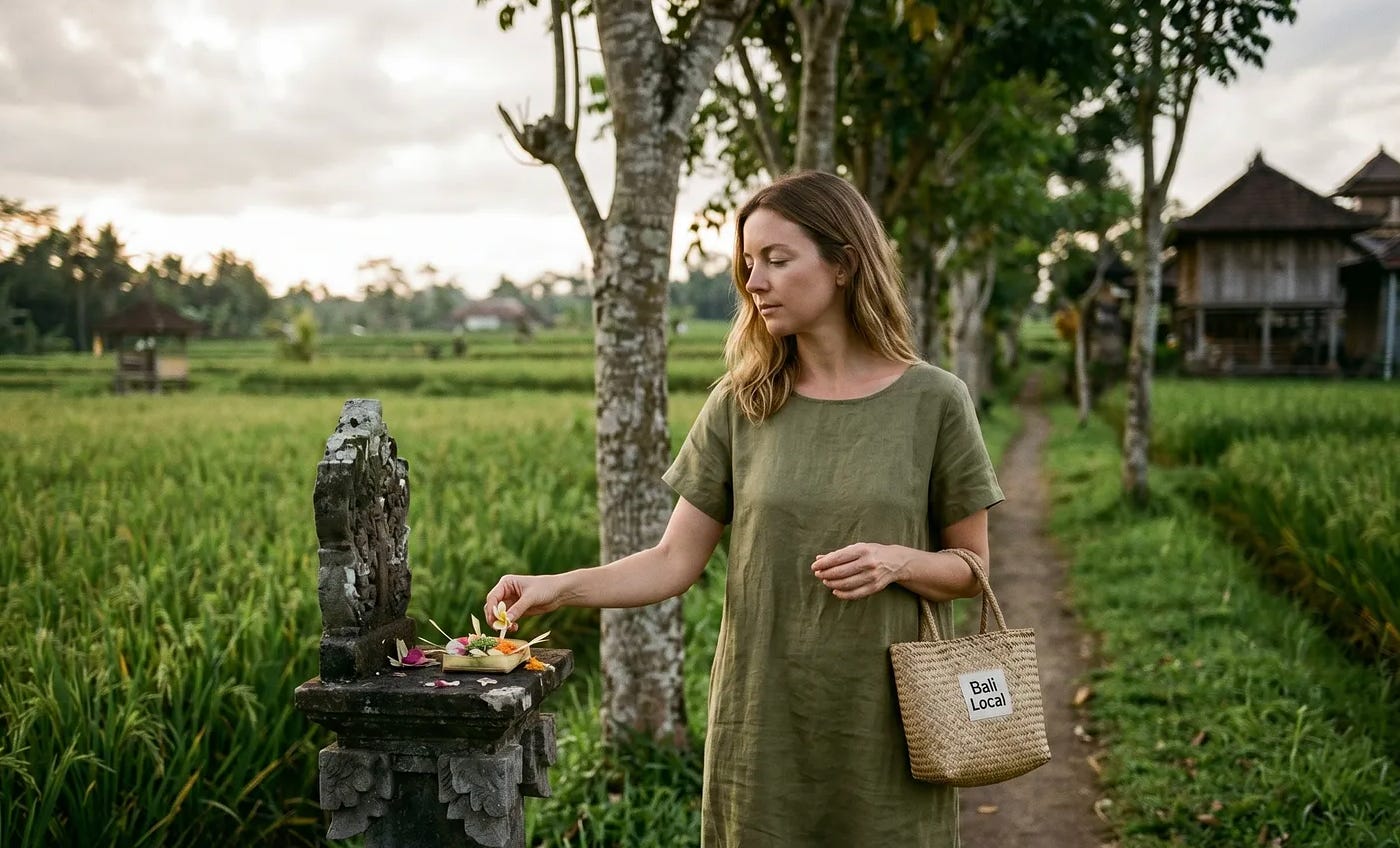
The Balinese spiritual life — the daily offerings, the temple ceremonies, the sound of gamelan at dusk, the pervasive sense of the sacred in the ordinary — continues with a devotion that tourism has not dented, despite its best efforts. There is something in the Balinese Hindu relationship to place and community that is more durable than the overlay of cafes and coworking spaces and Instagram aesthetics.
The landscape is still extraordinary. The rice terraces of Tegalalang and the interior valleys. The volcano reflected in the caldera lake at dawn. The green that arrives in wet season and saturates everything. These are not diminished by development, not yet, not fundamentally.
The warmth of the people, where it’s met with equivalent respect and effort, is real. My Balinese friendships — the ones built over time, through language and reciprocity and consistent presence — are not affected by the tourist numbers. They exist in a different register.
What Bali is at its core — the culture, the landscape, the particular quality of daily life that you can still access if you move towards the island rather than using it as a backdrop — is still there. Whether it will be in another decade is a more uncomfortable question.
How I’m Trying to Love It Responsibly
I don’t have a grand theory of responsible expat life in Bali. I have a set of practices that feel, at minimum, like the right direction.
I try to spend money locally and specifically: the family warung rather than the tourist restaurant, the local market rather than the expat supermarket, the Balinese guide rather than the international tour operator. I know this doesn’t transform a systemic problem but it does mean the money I spend in Bali circulates into the community rather than out of it.
I try to be respectful at sacred sites in a specific rather than performative way. Proper dress. Not photographing ceremonies in a way that treats them as entertainment. Not going where I’m not wanted. Asking before assuming.
I try to have honest conversations about the challenges, including in writing like this, because I think the expat narrative around Bali is too often purely celebratory in a way that doesn’t serve the place or the people in it.
And I try to hold the love and the complication simultaneously, because I think that’s actually what it means to love somewhere rather than to romanticise it.
Bali in 2026 is not the same as Bali in 2016. It will not be the same in 2036 either, and that change will bring some losses and some gains and some things that are simply different rather than better or worse.
I am going to stay, for as long as it makes sense. Not because the Bali I love is frozen in some perfect amber state — it isn’t, and it never was — but because the thing I love about it is still here, even if it requires more effort to find than it once did.
Loving a place that’s changing is not the same as loving a place that’s static. It requires more attention, more honesty, and more willingness to hold both the gratitude and the grief.
But it’s still love. And the island still earns it.
FAQs
Is Bali too touristy in 2026?
Busy tourist areas like Seminyak and parts of Canggu are extremely developed. Moving slightly off the main circuit — Sidemen, Amed, Munduk, quieter parts of Ubud — reveals a much less crowded island.
Is Bali sustainable for long-term tourism?
This is a serious and debated question. Bali faces real environmental and cultural pressures, and there are active conversations among Balinese communities, NGOs, and the Indonesian government about how to manage this.
What are the main concerns about tourism in Bali?
Environmental pressure (plastic waste, water, reef damage), disrespectful behaviour at sacred sites, rising costs of living for local Balinese, and the displacement of local communities by development are the most commonly cited.
Are there parts of Bali that are less developed?
Yes. East Bali (Amed, Tirta Gangga, Sidemen), North Bali (Lovina, Munduk), and inland areas remain considerably quieter and less developed than the south and southwest.
How can tourists and expats in Bali be more responsible?
Spend money at local businesses, dress and behave appropriately at sacred sites, learn some Bahasa Indonesia, avoid single-use plastics, use reputable guides, and stay informed about local community concerns.
What is the Indonesian government doing about Bali overtourism?
Measures have included visitor levies, regulations on tourist behaviour at sacred sites, crackdowns on illegal working, and ongoing debate about visitor caps and sustainable tourism frameworks.
Is it ethical to move to Bali as an expat?
This is a genuinely complex question without a simple answer. The economic benefits and cultural complications of foreign residents are real, and being honest about both is more useful than either uncritical enthusiasm or self-flagellation.
Is Bali’s culture under threat?
Balinese Hindu culture has demonstrated remarkable resilience over centuries of external pressure. Many Balinese people express concern about specific erosions while also expressing confidence in the culture’s durability. Both things can be true.
What is the future of Bali?
Unknown, and contested. Bali has always been a place of change — its history includes colonialism, independence, tourism waves, and significant external influence. How it navigates the current moment will depend on decisions made by Balinese communities, the Indonesian government, and the international visitors and residents who engage with it.
Can you still have an authentic experience in Bali?
Yes, but it increasingly requires intentionality: moving beyond the most developed areas, building genuine relationships with local people, learning the language, and engaging with the culture on its own terms rather than as a backdrop for your own experience.
A note from Annie
Destined for Bali shares my personal experiences, opinions, and independent research. Everything I write reflects what I’ve found to be true at the time of publishing — but Bali changes constantly, and what works for me may not work for you. Always do your own research and seek qualified professional advice before making decisions about travel, visas, property, business, health, or anything else that matters. Some links in my posts are affiliate links, meaning I may earn a small commission at no extra cost to you. Sponsored content is always clearly labelled. Read the full Terms and Privacy Policy.
© Destined for Bali