
There’s a particular kind of Bali neighbourhood story that repeats itself. A quiet fishing village or rice-field hamlet gets discovered by a handful of surfers and artists. Coffee shops appear. Coworking spaces follow. A few boutique villa developers notice the energy. Then, within a few years, it’s on every influencer’s must-visit list and the land prices have quadrupled. Seminyak. Then Canggu. Now, pretty clearly, Pererenan.
Pererenan sits at the northern end of the Canggu strip, bordered by Echo Beach to the south and the quieter Cemagi corridor to the north. It’s close enough to Canggu’s infrastructure to access the good cafés, the coworking spaces, the social scene — and far enough from Batu Bolong’s epicentre that it still has the rhythm of a place where people actually live rather than perform living.
I’ve watched it change over the past two years, and I want to write about it now, before it fully transforms, because the window of Pererenan-as-it-is is still open — if narrowing.
What Pererenan Feels Like Right Now
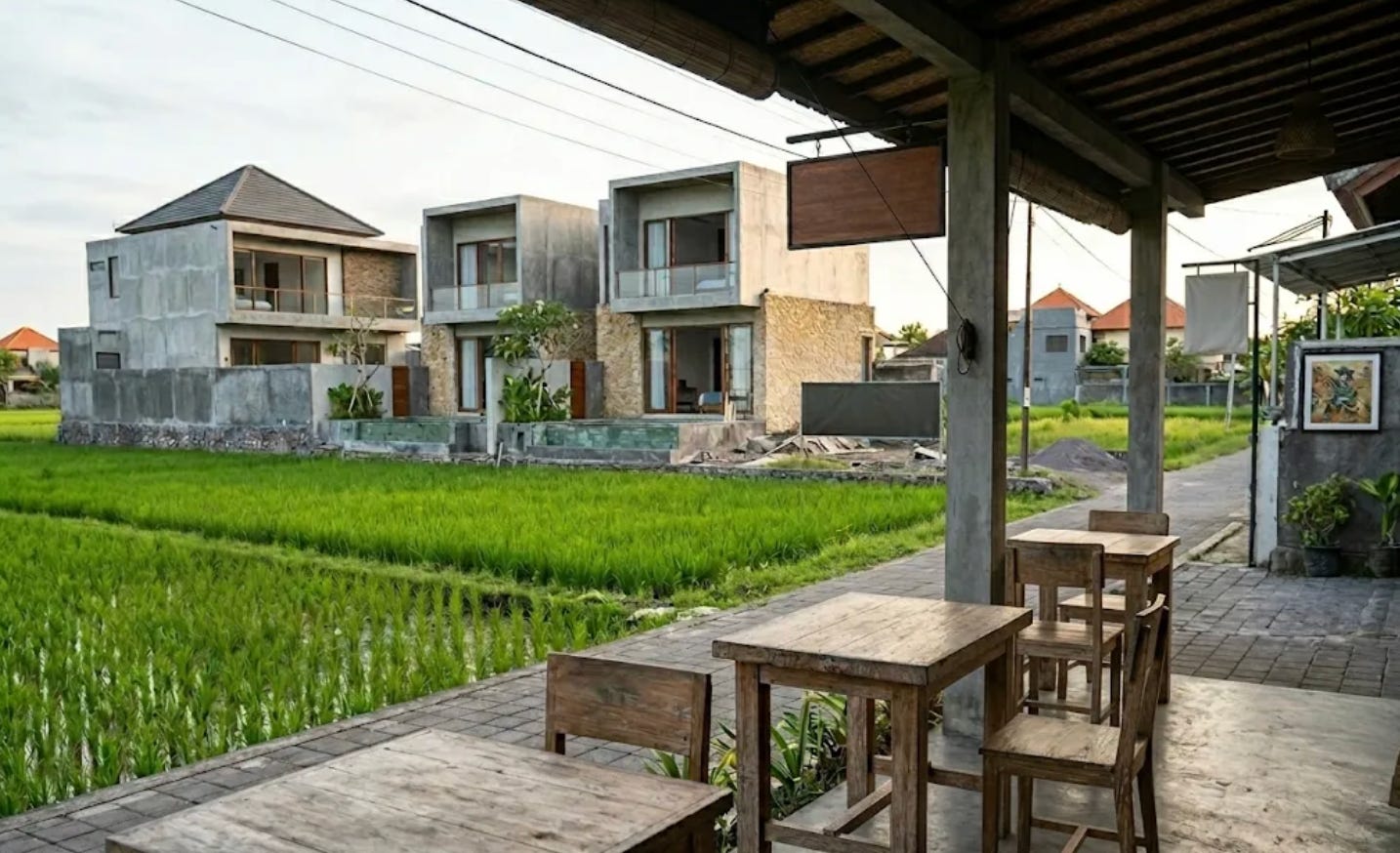
The rice fields are still there. Not as backdrop but as working landscape — green and actively farmed, with the irrigation channels and the cooperative management system (subak) that UNESCO protected in 2012. The sunsets over the rice paddies in Pererenan, with the sea visible in the distance and the sound of the irrigation water, are genuinely among the most beautiful things I’ve experienced in Bali.
The street scene is a mix of local warung culture and a slowly growing number of internationally oriented coffee shops and restaurants. There are fewer ATMs than in central Canggu. The roads are narrower. But the art galleries are exceptional — some of Bali’s best contemporary Balinese and international artists have studios in Pererenan and the adjacent Penestanan area, and the galleries that have opened here in the past few years are proper galleries, the kind that would sit comfortably in East London or Melbourne.
The accommodation mix still tilts towards expat long-term rentals rather than short-stay villa complexes. You see more families and more people who’ve been here for years than you do in central Canggu. The motorbike traffic is manageable. There’s a morning market that’s worth arriving at early.
Why Property People Are Paying Attention
Land prices in Pererenan are telling a story. In 2022, IDR 1.5–2 billion per are was the going rate for well-positioned land. By early 2026, prime positions are quoted at IDR 3–4.5 billion per are — still meaningfully below Batu Bolong’s IDR 5 billion+ but representing significant appreciation over a short period.
The investment thesis is straightforward: Pererenan sits at the intersection of the Canggu premium brand (the area is close enough to carry the association) and more accessible entry pricing. For buyers who missed Canggu at the right price point, Pererenan is where the comparable fundamentals currently exist — though it won’t stay that way indefinitely.
The rental market is performing strongly. Well-managed villas in Pererenan that were achieving USD 150–180 per night in 2023 are now commanding USD 200–280, driven by spillover demand from Canggu’s supply constraints and the area’s growing independent reputation. Gross rental yields for properties entering the market now, at current build and land costs, sit around 8–10% — more attractive than the 6–8% achievable in fully mature Canggu.
Several mid-scale villa developers have broken ground in Pererenan in the past 18 months. The pattern mirrors Canggu circa 2017: the pioneers are in, the followers are arriving, and the question is whether you’re buying at the beginning of the growth curve or somewhere in the middle of it.
The Restaurant and Café Scene: What’s Worth Knowing
The food scene in Pererenan has developed its own identity, distinct from Canggu’s well-trodden circuit. A few places worth knowing.
Warung-style eating remains the reliable morning option — local nasi campur, fresh fruit juice, Balinese coffee — at genuinely local prices. The warungs that serve the rice field-working community rather than the expat community are the ones worth finding, and they’re still there if you look slightly off the main road.
For the international café crowd, Pererenan has developed a small but genuinely good cluster. The standard here is specialty coffee, plant-forward menus, and architecture that uses the landscape rather than competing with it — open-sided, rice field-adjacent, the kind of space that makes you want to stay three hours rather than finish your coffee and move on.
The rice field-view restaurant concept, done thoughtfully, is best in Pererenan. In Canggu, this category has been so comprehensively executed that it’s become a cliché. In Pererenan, a few places do it with genuine restraint and beauty that hasn’t yet been copied into ubiquity.
What’s Coming: The Changes Already in Motion
It would be dishonest to write about Pererenan without acknowledging what’s already changing. Two years ago, the area had two or three internationally known cafés. Now there are perhaps fifteen. The villa development pace is visibly accelerating. The road to Echo Beach is noisy on weekend afternoons with the traffic that used to be a Canggu phenomenon.
The art gallery corridor along Jalan Raya Pererenan is becoming a destination rather than a discovery — which is good for the galleries and slightly less good for the feeling of stumbling into something unmarketed. Instagram has found the rice field views.
None of this means Pererenan is over. It means it’s in transition. The question for visitors and potential residents is whether they’re looking for Pererenan-as-it-was (still partly there, if you look) or whether they’re comfortable with Pererenan-as-it’s-becoming, which is a more refined, more expensive, still genuinely lovely version of the Canggu experience.
For property buyers, the transition is arguably the point. You’re not buying Pererenan for what it is today — you’re buying it because the trajectory is clear and the entry price hasn’t yet fully priced in where it’s going.
Living in Pererenan: The Practical Reality
Proximity to Canggu means the practical infrastructure of living here is close at hand. BIMC Kuta is about 20 minutes south. The Canggu coworking spaces — Dojo Bali, BWork — are a short motorbike ride. The best of Canggu’s restaurants, surf schools, and social scene are accessible without committing to Canggu’s traffic and density full-time.
Pererenan itself has enough daily infrastructure — a small but growing set of cafés, a morning market, hardware shops, motorbike mechanics, a reliable local clinic — that you don’t need to leave constantly. The balance between access and space is arguably the best of any area adjacent to Canggu right now.
Long-term villa rentals here are still negotiable in ways that central Canggu is not. Arriving with a one-year commitment and a reasonable opening offer can get you a two-bedroom villa with rice field views for IDR 130–200 million per year (approximately £6,500–10,000). That budget gets you very little in Batu Bolong.
FAQs
Where is Pererenan in relation to Canggu?
Pererenan sits at the northern end of the Canggu corridor, adjacent to Echo Beach and the quieter Cemagi area. It’s approximately a 10–15 minute motorbike ride from central Canggu (Batu Bolong).
Is Pererenan good for digital nomads?
Yes — the proximity to Canggu’s coworking infrastructure (Dojo Bali, BWork) combined with Pererenan’s quieter, more spacious character makes it an appealing base. Coffee shops with good wifi are established and growing. It suits nomads who want Canggu’s amenities without Canggu’s density.
How much does it cost to rent in Pererenan?
Long-term villa rentals (one year or more) in Pererenan run approximately IDR 130–220 million per year (£6,500–11,000) for a two-bedroom villa, depending on finish and position. Some properties with rice field views are available at the lower end of this range with negotiation.
Is Pererenan good for property investment in 2026?
The investment fundamentals look compelling: entry prices still below mature Canggu levels, clear price appreciation trajectory, improving rental yields. Buyers entering now are likely catching the growth curve mid-rise rather than at the beginning, but the upside appears stronger than in central Canggu.
What is the art scene like in Pererenan?
Pererenan and adjacent Penestanan have become one of Bali’s most serious contemporary art corridors, with galleries showing both international artists and exceptional Balinese painters. Several significant Balinese artists have studios in the area. The galleries here are the real thing.
Does Pererenan have good restaurants?
A small but growing set of excellent cafés and restaurants, particularly those with rice field positions. The local warung culture is still intact. The area is developing its own identity distinct from Canggu’s more saturated dining scene.
Is Pererenan still quiet compared to Canggu?
Quieter, yes — noticeably less traffic, more open space, less weekend tourist density. But it’s developing. The gap has narrowed over 2024–2026 and will continue to narrow as development accelerates.
⚠️ Important disclaimer — please read carefully
This article reflects my personal experience and independent research only. It is not legal, immigration, financial, tax, business, medical, or professional advice of any kind, and should not be relied on as such.
Indonesian laws, visa rules, property regulations, tax requirements, and safety conditions change frequently and vary depending on your nationality, circumstances, and timing. Mistakes in these areas can carry serious consequences — including financial loss, deportation, legal liability, or harm to your health and safety.
Before making any decision based on this article, you must consult a qualified, regulated professional appropriate to your situation — such as an Indonesian immigration agent, lawyer, notary (PPAT), accountant, doctor, or licensed operator. I accept no responsibility for any decisions or actions you take based on what you read here.
Some links may be affiliate links, meaning I may earn a small commission at no extra cost to you. Sponsored content is clearly labelled. Full Terms of Service and Privacy Policy.