

The question I get asked most by remote workers considering Bali: “Is it legal to work here?” The answer changed significantly in 2022 and has solidified in 2026. Yes. Very legally. In fact, there are now two visa pathways designed specifically for remote workers, and knowing which one suits your situation is genuinely valuable.
This is not visa-run territory anymore. You’re not exploiting a loophole. Indonesia government literally designed visas for people like you. And the tax implications are absolutely worth understanding.
Here’s what actually works in 2026, and why it matters.
The B211A Visa: Six Months Tax-Free
This is the headline: the B211A visa allows you to stay in Indonesia for six months and earn tax-free income, provided that income is earned outside Indonesia (i.e., from clients/employment overseas, not from Indonesian sources).
How it works: You apply at an Indonesian immigration office or through an authorised visa agent. Requirements are minimal: return flight proof, accommodation booking, evidence of income (bank statements showing deposits, employment letter, freelance client contracts — something showing you’re legitimately earning). Once approved, you receive a single-entry visa stamp in your passport allowing six-month residence.
Tax benefit: Income earned while on B211A is not subject to Indonesian income tax if it’s from foreign sources. This is the game-changer. A freelancer earning USD 5,000/month from US clients: zero Indonesian tax owed. It’s explicitly excluded.
Timeline: Application can be done at Indonesian embassy in your home country (allows entry), or you can get a tourist visa, enter Indonesia, then convert to B211A once you’re in (more commonly done by digital nomads). Processing: 7–14 days if you hire an agent (cost: IDR 1.5–2 million, approximately USD 100–130).
Conditions:
Must be a genuine remote worker (cannot work for Indonesian employers)
Cannot work on Indonesian contracts (even if paying you for remote work, if based in Indonesia, that’s taxable)
Income must be demonstrably from outside Indonesia
Must maintain accommodation (provides address for registration)
After six months: You can either return home (exit + re-enter), or switch to another visa if you want to stay longer.
The E33G Visa: The Emerging Option
Newer (2024), not yet widely known, and genuinely interesting: the E33G visa, designed for remote workers and digital nomads, allows one-year residence with flexibility. Currently in pilot phase in select locations including Bali.
Key details: Currently in pilot phase in certain Indonesian provinces (Bali is one of them). Allows 12-month residence for remote workers. The tax treatment is similar to B211A (foreign-source income tax-exempt), but with longer validity.
Application requirements: Evidence of income (USD 2,000+ monthly is guideline), health insurance, passport validity, accommodation booking. No return flight required.
Timeline: Slower processing than B211A (3–4 weeks typical). Cost: IDR 2–3 million (approximately USD 130–200) through agent.
Advantages vs B211A: One-year validity (you don’t re-enter every six months). More flexible extension pathway (moving between Bali/other provinces). Recognition from government as a remote worker category.
Current status: Expanding, but not everywhere yet. Bali, Jakarta, Yogyakarta are your best bets. Check your nearest immigration office for local availability.
Tax Reality: What Actually Happens With Income
This is where precision matters because misinformation is widespread.
Foreign-source income on B211A: Exempt from Indonesian income tax. You do NOT file Indonesian tax returns on USD earnings from US/UK/Australian clients. This is explicit in the visa conditions.
Indonesian-source income: Taxable at 5–30% depending on income level, regardless of visa status. If you do any work for Indonesian clients, or have any income generated in Indonesia (freelance project scoped in Indonesia, even if client is foreign), that’s taxable.
Tax residency: After 183 days in Indonesia in a calendar year, you may be considered a tax resident and subject to worldwide income tax. HOWEVER: the B211A visa exemption still applies to foreign-source income even as a resident. The Indonesian tax authority has clarified this distinction — you’re a resident but foreign income remains exempt.
Compliance: You don’t need to file Indonesian tax returns if your income is purely foreign-source. You should file in your home country (you’re a citizen, likely still have reporting obligations). Some countries (US, UK) require FATCA/tax reporting regardless. Consult your home country’s tax authority.
Safe play: Work with an accountant familiar with Indonesian expat tax law. The compliance cost (USD 300–500 per year) is insurance against misunderstanding your obligations.
Other Visa Options for Remote Workers (If B211A/E33G Don’t Fit)
Social/Cultural Visit (B211): Often available for 60-day extensions. Less formal than B211A, works for shorter-term digital nomads.
Business Visa (B211B): If you’re planning to start an Indonesian business alongside remote work, this pathway exists, but it’s more complex and triggers different tax obligations.
Multiple Tourist Visas + Runs: The “old way” — enter on 30-day tourist visa, extend once for 30 days (total 60 days in-country), exit and re-enter. This still works but lacks the tax benefits of B211A and is operationally tedious.
Family/Spouse Visa: If married to an Indonesian, different rules apply. Speak with immigration specialist.
Tax Planning: Legitimate Strategies
Income timing: If you’re on the edge of Indonesian tax residency (182 vs 183 days), timing your exit intentionally matters. Some remote workers do a “Bali for 180 days, then Thailand for 30” rotation, maintaining non-resident status. Legitimate.
Entity structure: Some high-income remote workers establish legal business entities in tax-friendly jurisdictions (Singapore, for example), become employees of that entity, and the entity pays them. Income within the entity is taxed favorably; salary withdrawal to Bali on B211A is exempt from Indonesian tax. Complex, but legitimate if set up correctly.
Home country deductions: Wherever you’re tax-domiciled, you may be able to deduct equipment, workspace setup, continuing education, etc. Take these deductions in your home country.
Practical Workflow: How to Actually Do This
Step 1: Determine your visa
Staying 1–6 months? B211A.
Staying 6–12 months? E33G if available in your location, otherwise B211A + extend/re-enter.
Staying 1–2 years? Consider whether to optimize with tax entity or just maintain B211A extensions.
Step 2: Prepare documentation
Passport (must be valid 6+ months beyond visa date)
Proof of income (recent bank statements, employment letter, client contracts)
Flight booking (return flight within visa timeline)
Accommodation booking (airbnb, hotel, long-term rental confirmation)
Travel insurance (recommended for health coverage and visa requirements)
Step 3: Apply
Option A: Apply at Indonesian embassy before traveling (allows entry visa)
Option B: Enter on tourist visa (much simpler), then convert to B211A once you’re in Indonesia (through visa agent)
Most digital nomads use Option B (less bureaucratic upfront, faster)
Step 4: Register locally
Once you arrive, register with local immigration office (KITAS registration). The property manager or visa agent usually handles this.
Costs: approximately IDR 300k (processing fees)
Step 5: Plan your tax situation
Consult accountant in your home country about reporting obligations
Consider whether to file an Indonesian tax return (you can voluntarily, even if exempt, for recordkeeping)
Set aside 15–20% of income for home-country tax if you’re subject to self-employment tax
Step 6: Before visa expires
Option 1: Exit Indonesia, re-enter on new B211A (can be done same day)
Option 2: Convert to another visa category if staying longer
Option 3: Process E33G extension if eligible
The Honest Bit: Common Mistakes
Mistake 1: Assuming all income is tax-free. Only foreign-source income on B211A is exempt. Any income from Indonesian sources (teaching, local clients, rental property in Indonesia) is taxable.
Mistake 2: Not registering locally and hoping nobody notices. Immigration records are cross-referenced with bank accounts. You want to be documented correctly.
Mistake 3: Working for Indonesian companies while on B211A. This violates visa conditions and makes your income taxable. If your remote work converts to a local employment contract, switch to a different visa.
Mistake 4: Ignoring home-country tax obligations. You’re still liable for taxes in your citizenship country, even while in Bali. Consult a tax professional.
Mistake 5: Overstaying. The six-month B211A expires; if you haven’t exited or converted to another visa, you’re in violation. Fines are steep, exit bans possible.
Cost Summary
Item Cost B211A visa (via agent) IDR 1.5–2 million (USD 100–130) Local registration IDR 300k (USD 20) Immigration-related Total: USD 120–150 Accountant/tax planning USD 300–500 (one-time setup) Annual home-country accounting USD 200–400 Annual total cost USD 320–900
This is noise compared to the tax savings on foreign-source income. For a USD 5,000/month remote worker, avoiding Indonesian income tax is worth USD 3,000–6,000 annually.
A Year-Long Remote Work Scenario
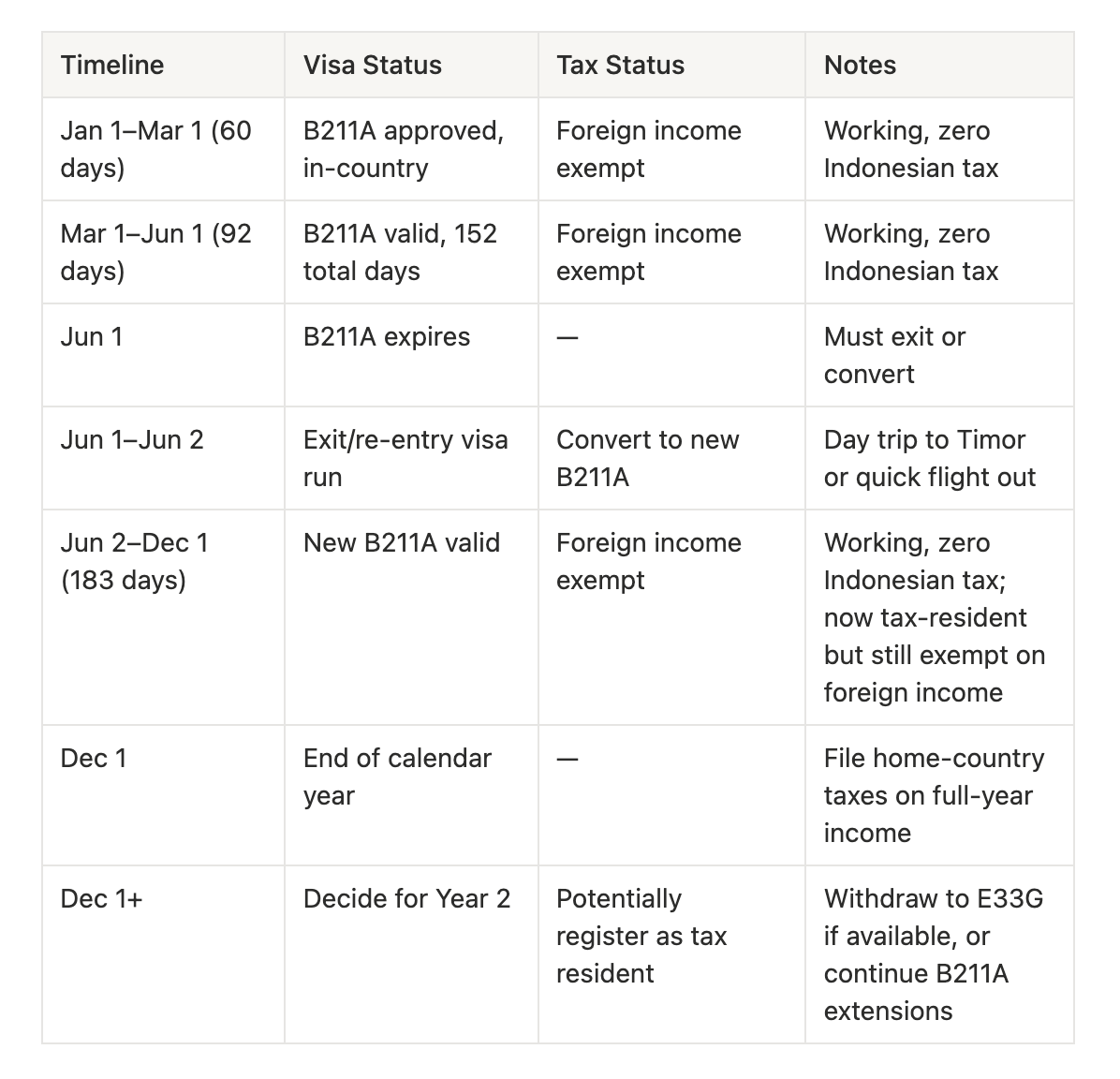
Working remotely from Bali in 2026 is not a grey-area situation. It’s a legitimate visa-backed activity with explicit tax benefits. The B211A visa provides six-month residence with tax-free foreign income. The emerging E33G offers year-long residence with similar benefits.
The key is documentation, registration, and not confusing foreign-source income exemption with a blanket tax holiday. Do it correctly, and you have a legally sound, tax-optimised base for remote work. Do it casually, and you’re creating liability.
Hire a visa agent (USD 100–130), register locally (USD 20), consult an accountant (USD 300–500), and you’ve eliminated 95% of the legal risk. That’s cheap insurance for the privilege of working from Bali tax-free.
FAQs
Q: Do I need a visa if I’m just visiting for two weeks?
A: No. Tourist visa (30 days, free on arrival for most nationalities) covers it. B211A is for stays beyond 30–60 days.
Q: Can I work for Indonesian companies on B211A?
A: No. If your employer is Indonesian-based, you need a different visa (work visa/business visa), and your income becomes taxable.
Q: What if I already overstayed as a tourist and didn’t apply for B211A?
A: Contact an immigration lawyer. Overstay fines are daily accumulation. Best fix: Exit, pay fine at airport, re-enter on B211A.
Q: Is E33G available everywhere or just certain areas?
A: Pilot program, certain provinces only. Bali, Jakarta, Yogyakarta are active. Check with local immigration office for your location.
Q: Do I need travel insurance to qualify for B211A?
A: Not officially required, but highly recommended. Many insurance policies specifically cover digital nomads on visa stays.
Q: Can my spouse also get a B211A if she’s unemployed?
A: Not typically. B211A requires proof of income. A spouse without income would use a family/dependent visa (different pathway).
Q: What if my client is Australian but I’m on B211A?
A: That’s fine. Foreign-source income (client location), not where you are, determines exemption. Australian client = foreign-source = exempt.
Q: Can I switch from B211A to E33G mid-stay?
A: Yes, if E33G is available in your location. You’d apply for conversion (immigration office), and the process typically takes 1–2 weeks.
Q: Do I need a lawyer to set up B211A?
A: No. A visa agent (cheaper, USD 100–130) can handle it. Lawyer is overkill for a standard B211A application.
Q: What’s the difference between B211A and tourist visa extension?
A: Tourist visa extension (60 days total) is simpler but shorter. B211A (180 days, renewable) is designed for workers, has tax benefits, and is the intended pathway for remote work.
⚠️ Important disclaimer — please read carefully
This article reflects my personal experience and independent research only. It is not legal, immigration, financial, tax, business, medical, or professional advice of any kind, and should not be relied on as such.
Indonesian laws, visa rules, property regulations, tax requirements, and safety conditions change frequently and vary depending on your nationality, circumstances, and timing. Mistakes in these areas can carry serious consequences — including financial loss, deportation, legal liability, or harm to your health and safety.
Before making any decision based on this article, you must consult a qualified, regulated professional appropriate to your situation — such as an Indonesian immigration agent, lawyer, notary (PPAT), accountant, doctor, or licensed operator. I accept no responsibility for any decisions or actions you take based on what you read here.
Some links may be affiliate links, meaning I may earn a small commission at no extra cost to you. Sponsored content is clearly labelled. Full Terms of Service and Privacy Policy.