

I was three months into working from Bali when it hit me. I was sitting in a café in Canggu, laptop open, answering emails for my UK employer, and I suddenly thought: am I even allowed to be doing this? Is my visa legal? Am I meant to be paying taxes here? In the UK? Both?
I’d done the bare minimum before arriving. Tourist visa ticked. Flight booked. Accommodation sorted. But the legal and financial side? I’d kind of assumed it would just work itself out. Spoiler: it doesn’t.
Working from Bali on a UK passport is absolutely doable, but it’s not a grey area that sorts itself out. It’s a specific situation with real visa rules, tax obligations in two countries, and genuinely important compliance steps that most of us—me included—don’t think about until we’re already here.
I’m writing this because I’ve now spent years figuring this out properly, I’ve made some of the mistakes I’ll tell you about, and I’ve learned what the actual legal picture looks like. This isn’t financial or legal advice—you’ll need to consult a UK accountant and an Indonesian immigration lawyer for your personal situation—but this is what I wish someone had told me clearly before I arrived. Let me walk you through it.
Visa Options for UK Nationals: Which One Is Actually Legal?
This is where most people get stuck. There are several visas you could theoretically stay on, but only some of them actually let you work.
The B211A Tourist Visa (Visit Visa)
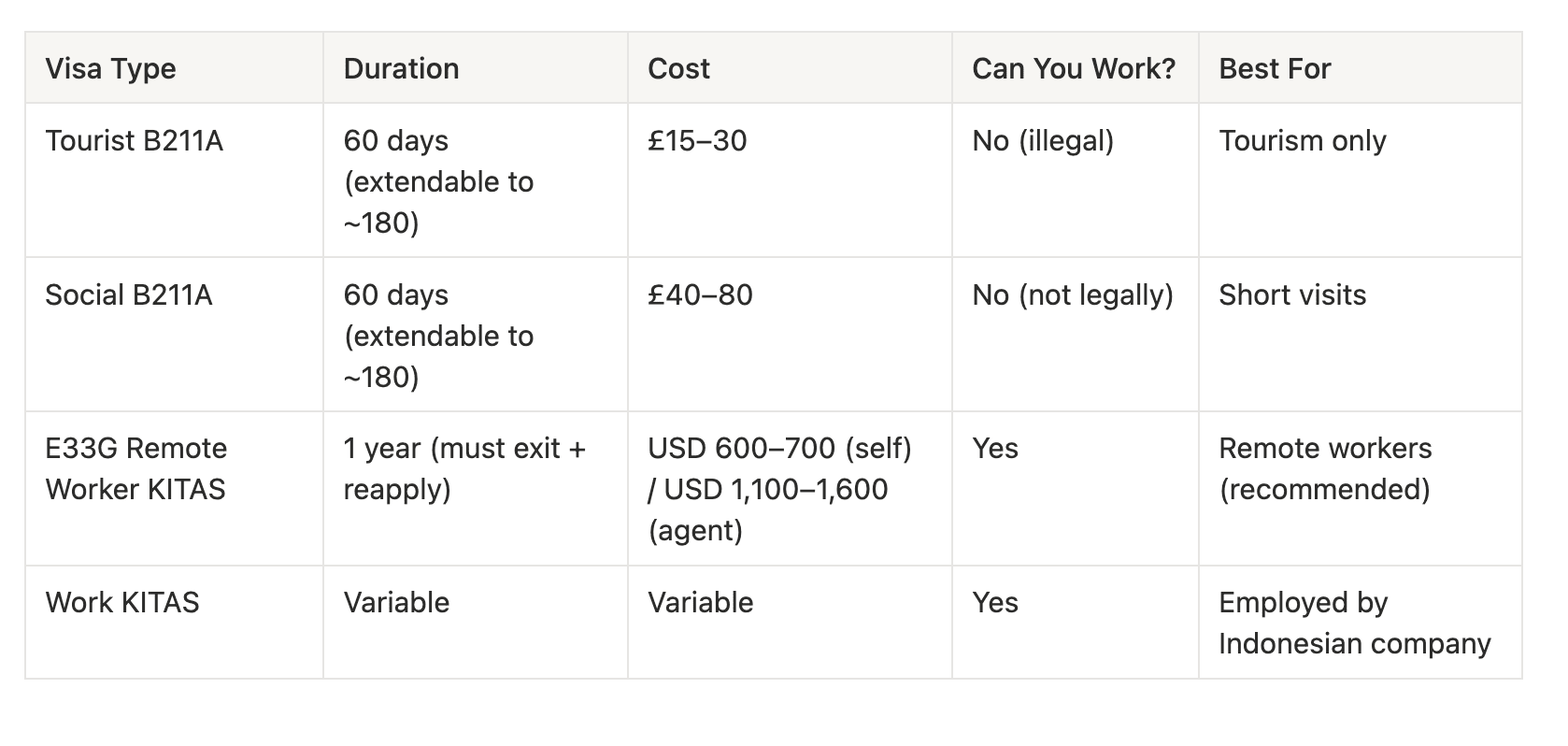
This is the easy one to get, which is why most people arrive on it. You get 60 days on arrival, and you can extend it to roughly 180 days total. The visa is cheap (around £15 for a visa-on-arrival if you’re a UK national). But here’s the thing: working on a tourist visa is not legal. It doesn’t matter if you’re working remotely for a UK company, freelancing for foreign clients, or running your own online business—legally, you can’t do any of it on a B211A.
Now, in practice, lots of people do work on tourist visas. The immigration office isn’t actively checking if you’re working whilst sitting in a café. But in 2025, immigration enforcement in Bali intensified significantly. There were 331 deportations from Ngurah Rai immigration office in 2025 alone. So “nobody gets caught” isn’t a strategy I’d recommend.
The B211A Social Visa (Extended Stay Visa)
Not to be confused with the tourist B211A above—this is a single-entry social visit visa valid for 60 days, extendable to 180 days. It’s sometimes used by remote workers, but it has the same legal problem: it doesn’t officially allow you to work. Many people use it as a stopgap, but legally it’s in the same grey area as the tourist visa.
The E33G Remote Worker Visa (KITAS)
This is the visa designed specifically for you. It’s technically called a KITAS—Kartu Izin Tinggal Terbatas, a Temporary Stay Permit—but it’s formally the E33G Remote Worker Visa or Remote Worker Permit.
This visa is for people who work remotely for companies or clients based outside Indonesia. You must earn at least USD 60,000 per year. You need proof of employment (contract, payslips, or business registration), valid health insurance covering your stay, a passport valid for at least 18 months, and accommodation proof (lease or hotel booking). The visa is valid for 1 year and costs approximately:
Self-processing (apply offshore): USD 600–700 total
Using a visa agent: USD 1,100–1,600 total
Using an agent adds cost but provides peace of mind and handles the paperwork. You cannot renew it in-country; you must exit Indonesia and reapply.
The upside: it’s entirely legal. You can work, you’re compliant with immigration, and you have documentation to back up your status if needed.
The KITAS B211A (Work Permit)
There’s also a legitimate KITAS for people who work for Indonesian employers—but this isn’t you if you’re working remotely for a UK company. Skip this one.
Visa Comparison Table
Your UK Tax Obligations When Working Abroad
This is where it gets complicated, because you still owe tax to the UK in many situations—even though you’re physically in Bali.
Your UK tax liability depends on your residency status. HMRC uses something called the Statutory Residence Test (SRT) to work this out. Essentially, are you a UK resident for tax purposes, or are you a non-resident?
You’re automatically a UK resident if you spend 183 days or more in the UK during a tax year, or if the UK is your only or main home. You’re automatically non-resident if you spend fewer than 16 days in the UK and don’t work in the UK, or if you’re working full-time abroad (at least 35 hours per week) and spend fewer than 91 days in the UK with fewer than 30 of those days working in the UK.
If you fall in between, it’s more complex, and you need professional advice.
Why does this matter? If you’re a UK resident for tax purposes, you owe UK income tax on your worldwide income—including what you earn from remote work in Bali. If you’re non-resident, you only pay UK tax on UK-sourced income (and you still might owe tax in Indonesia, which I’ll come to next).
Here’s something crucial: notify HMRC when you leave the UK using form P85. It’s not technically mandatory, but it’s practically essential. It tells HMRC to review your tax position. You might get a refund if you’ve overpaid through PAYE. Also note: from April 2026, voluntary Class 2 National Insurance contributions for people working abroad are ending. Only Class 3 contributions will be available at higher cost, which makes the decision about your residency status even more important.
What Indonesian Tax Law Actually Says About You
Indonesia has its own rules, and they interact with the UK ones in ways that can trip you up. If you’re on a KITAS or a long-term contract, Indonesia considers you a tax-paying resident from the day you arrive. If you spend more than 183 days in Indonesia within 12 months, you’re also treated as a tax resident. Once you’re a tax resident of Indonesia, your global income falls under Indonesian tax obligations.
But here’s the thing: if you’re a UK resident and you also become an Indonesian tax resident, both countries might claim tax on the same income. That’s where double-taxation treaties come in. The UK and Indonesia have a treaty to prevent this, but it requires filing and careful documentation. You cannot just ignore it and hope it goes away.
If you’re working on a tourist visa and technically not meant to be working, you’re also not meant to be paying Indonesian income tax on that income, which means you’re in a contradictory position. You’re not compliant with immigration law, and your tax position is ambiguous. This is the actual risk.
For remote workers on a legitimate E33G visa, Indonesian income tax still applies to your foreign-sourced income because you’re classified as a tax resident. The tax rate is 5–35% depending on your income band (the 35% band applies to the highest earners), plus social security contributions if you’re an employee. Again: consult a qualified Indonesian tax accountant. The rules are specific and the penalties for getting it wrong are real.
Getting Set Up Properly: Bank Accounts, Insurance & Contracts
Once you’ve sorted your visa and understood the tax picture, you need to actually set things up.
Local Bank Account
You’ll want a bank account with a local Indonesian bank. Most banks (BCA, Mandiri, BNI) will open an account for foreigners with a passport and a local address or accommodation proof. This makes it easier to receive payments, pay bills, and have documentation for tax purposes.
Health Insurance
This is required for your E33G visa, but it’s also just sensible. Indonesian healthcare is affordable and often excellent (especially in Bali), but you need coverage. International travel insurance is fine; some policies are specific to Indonesia. Budget USD 400–1,000 per year depending on coverage.
Your Employment Contract
If you’re employed by a UK company, make sure your contract is clear about the fact that you’re working abroad. Some contracts have clauses about where you can work or tax implications. Clarify it with your employer.
If you’re freelancing or running your own business, keep clear records of your clients (location), invoices, and payments. This documentation matters for both tax authorities.
The Mistakes I’ve Seen (And How to Avoid Them)
Thinking the tourist visa is fine because “everyone does it”
Yes, many people work on tourist visas. But enforcement is increasing, and the consequences of getting caught are serious: fines, deportation, and a ban on re-entry. It’s not worth it.
Assuming UK taxes don’t apply because you’re abroad
If you’re still a UK resident for tax purposes, you still owe UK tax on your worldwide income. Not notifying HMRC, not filing returns, or assuming it’s all handled by your employer creates real problems. It doesn’t.
Not keeping any records of your income
Both the UK and Indonesia want documentation. Bank statements, invoices, contracts, payslips—keep them. When tax time comes, you’ll be grateful.
Getting a KITAS and assuming that’s the end of compliance
The visa is one part. You still need to understand your tax obligations in both countries and file accordingly.
Not getting proper advice before you arrive
Consult a UK accountant and an Indonesian immigration lawyer before you move. It costs money upfront, but it saves a lot of stress and potential fines later.
Working from Bali as a UK national is entirely legal and doable. But it requires more than just booking a flight and finding a café with decent WiFi.
You need the right visa (almost certainly the E33G). You need to understand whether you’re a UK tax resident and file accordingly. You need to know that Indonesia might also consider you a tax resident. You need health insurance, a bank account, and clear records. And you need professional advice tailored to your specific situation.
I know that sounds like a lot. It is more complex than I initially thought. But once you’ve sorted it—and it really is a one-time sort—it becomes quite straightforward. I’ve been working from Bali for years now, and I’m completely compliant, sleeping well at night, and not worried about immigration showing up. That peace of mind is worth the effort it takes to get it right.
FAQs
1. Can I work on a tourist visa if I’m working for a foreign company?
No. It’s illegal, regardless of where your employer is based. The tourist visa doesn’t allow work of any kind. You need an E33G Remote Worker Visa.
2. How much does the E33G visa cost?
Approximately USD 600–700 for self-processing (applying offshore yourself), or USD 1,100–1,600 if you use a visa service provider. The agent option includes peace of mind and paperwork handling.
3. Do I have to pay UK income tax if I’m working from Bali?
It depends on your UK tax residency status. If you’re non-resident for tax purposes (fewer than 16 days in the UK, or working full-time abroad with specific conditions), you don’t owe UK income tax on foreign-sourced income. If you’re still classified as a UK resident, you do. Consult HMRC or a UK accountant.
4. Am I taxable in Indonesia if I’m working remotely?
If you have an E33G visa or a long-term contract, Indonesia classifies you as a tax resident from day one. If you stay more than 183 days, you’re also a tax resident. Once you’re a tax resident, you may owe Indonesian income tax on your global income. Consult an Indonesian tax accountant.
5. How long can I stay on a tourist visa?
You get 60 days on arrival, and you can extend for another 30 days, giving you roughly 180 days total. But you cannot work during this time legally.
6. Can I renew my E33G visa whilst I’m in Indonesia?
No. The E33G is valid for 1 year, and you must exit Indonesia and reapply. You cannot extend it in-country.
7. What health insurance do I need for the E33G?
You need valid health insurance covering your stay in Indonesia. International travel insurance, expat insurance, or Indonesian-specific policies all work. It must be active for the duration of your visa.
8. Do I need to declare my global income to Indonesia?
As a tax resident of Indonesia (whether on a KITAS or after 183 days), your global income is technically taxable in Indonesia under the double-taxation treaty with the UK. Proper documentation and filing are essential. Consult an Indonesian tax professional.
9. What happens if I overstay my visa?
You’ll face fines (roughly IDR 1 million per day, paid at the airport), potential deportation, and possibly a ban on re-entry for several years. Don’t overstay.
10. Can I open a bank account as a foreigner in Indonesia?
Yes. Most major Indonesian banks (BCA, Mandiri, BNI) will open accounts for foreigners with a valid passport and proof of local accommodation. It typically takes a few days.
DISCLAIMER
⚠️ Important disclaimer — please read carefully
This article reflects my personal experience and independent research only. It is not legal, immigration, financial, tax, business, medical, or professional advice of any kind, and should not be relied on as such.
Indonesian laws, visa rules, property regulations, tax requirements, and safety conditions change frequently and vary depending on your nationality, circumstances, and timing. Mistakes in these areas can carry serious consequences — including financial loss, deportation, legal liability, or harm to your health and safety.
Before making any decision based on this article, you must consult a qualified, regulated professional appropriate to your situation — such as an Indonesian immigration agent, lawyer, notary (PPAT), accountant, doctor, or licensed operator. I accept no responsibility for any decisions or actions you take based on what you read here.
Some links may be affiliate links, meaning I may earn a small commission at no extra cost to you. Sponsored content is clearly labelled. Full Terms of Service and Privacy Policy.